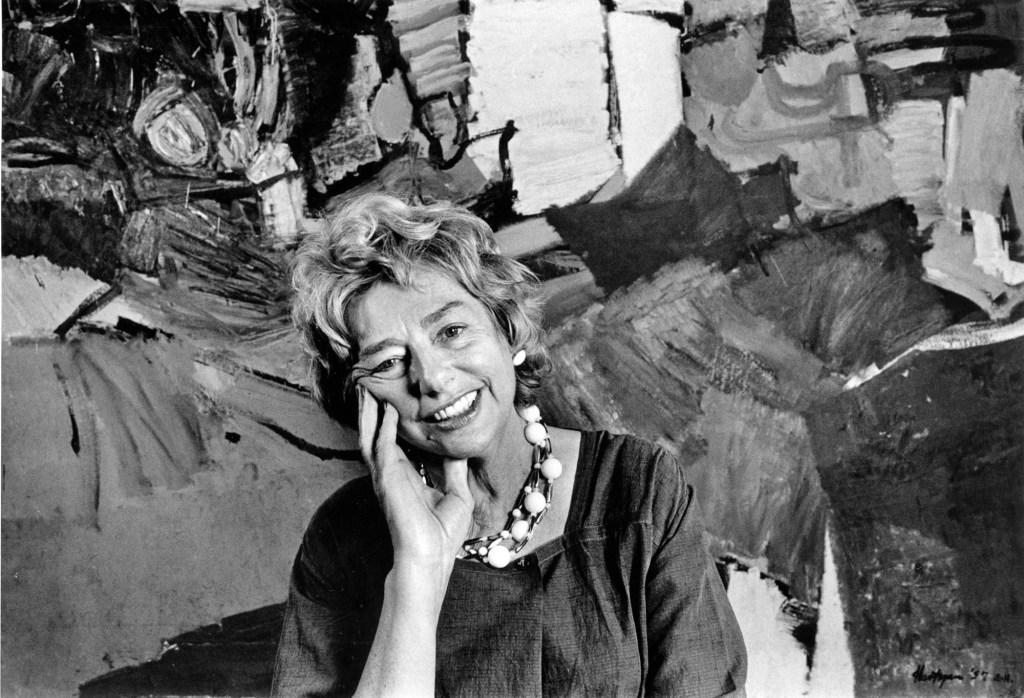
The first of the second generation Abstract Expressionists, Grace Hartigan was a key figure in art herstory. She started the wave of experimental brushwork and bold strokes, switching between abstraction and figuration freely and with ease, that would become hallmark in abstract art there after. Often exploring the interplay between pop culture and everyday life, Hartigan made sure that there were “no rules” when it came to her art; “I must be free to paint anything I feel”. It is fair to say she was one of the founders of the pop art movement as much of her work focuses on the low culture of her time. Her artistic freedom wasn’t only in her work but in the way she lived her life. Up until 1954 Grace exhibited under the name George. For practical reasons, as men’s work was more highly valued but also because Grace believed that identity was fluid and if womanhood was based on behavior then she may as well be a man too. She was known to revere her work over family, wear men’s clothing, and throw around a spicy word or two. “No rules” truly is a perfect way to sum up not only her work but her contribution to the art world as a whole. We can learn from her that our identities are never set in stone, this way or that, one thing or another. We are whatever we choose to be in this moment, and can be something else in the next.
“If you’re an extraordinarily gifted woman, the door is open. What women are fighting for is the right to be as mediocre as men.”
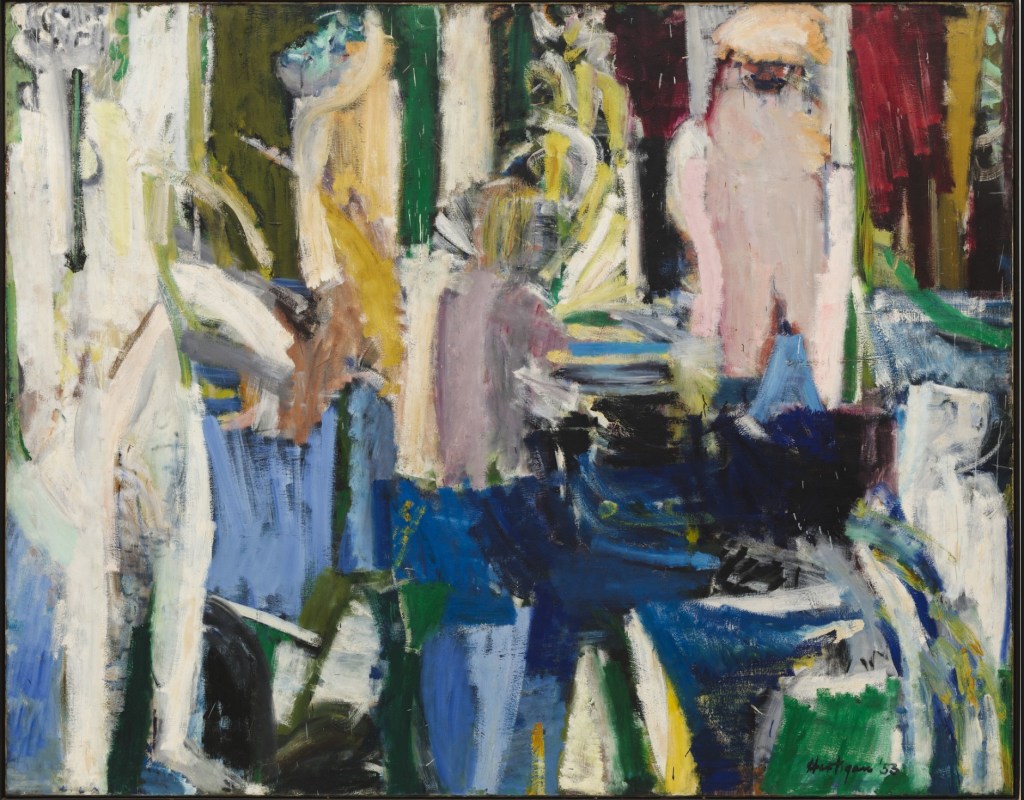
I think this piece is a wonderful example of Hartigan’s style for most of her career. Big, bold brush strokes that feel almost experimental. I get a sense that each one was thrown down with the notion ‘mmm yes that looks good’, and if not perhaps covered with another big swath of some other color. I was also drawn to this particular piece because of its similarity to Cézzane’s Large Bathers painting. In reality Hartigan was actually inspired by Matisse’s piece Bathers by a River which she saw during a retrospective at the MoMA. Either way, without the prior bias that a painting called ‘river bathers’ would probably denote some sort of naked woman as is often the case (ie. Matisse’s Bathers by a River, Cézzane’s Large Bathers, Rembrandt’s A Woman bathing in a Stream … I could go on…) one may find it hard to find any female bodily attributes to the rough figures. If we look closer however we can see the hint of boobies and pubes in some of the figures, some long tresses of hair on others. We can imagine that some of the figures must be in the water, which I see as the large blue patches, while some are on the earth, like the figure on the left in the foreground. While the brush strokes and colors are frantic and wild I still feel a sense of calmness in the scene being presented- do you feel this as well? Let me know in the comments what you think.
Another fun way to think about art while we look at it is the way in which the medium is handled. In this case Hartigan used oil paints. When using oil paints, because they take so long to dry out, often times artists with have colors mixed all over the pallets. A hue here and tone there, all the colors blending in different spots and they mix and mix and mix. So with this in mind I look at this piece and consider that these colors shouldn’t look good together- in fact some are sort of muddy, like the color of the figure in the very middle. Yet, they do look good together as none of the colors are really screaming at me. Wanna know why? Because each color has a bit of all the other colors in it which brings harmony to a piece; it’s called unifying your color pallet. It’s a neat trick to make sure no one color dominated a piece.
“I cannot expect even my own art to provide all of the answers, only to hope it keeps asking the right questions.”
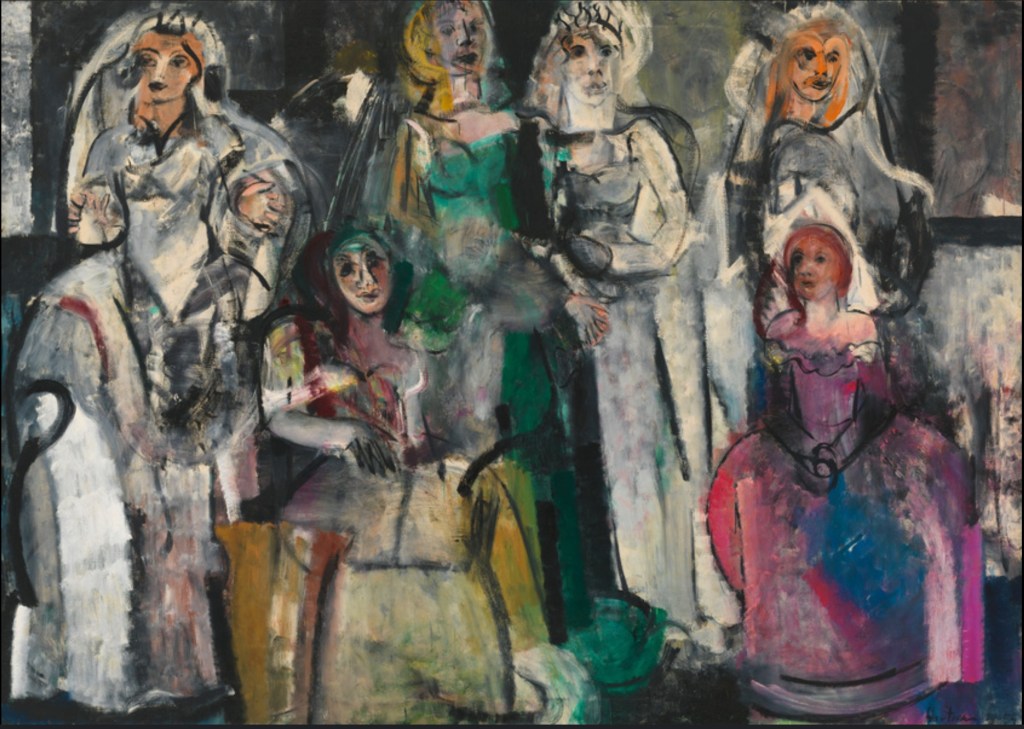
This is one of my favorite works I saw when researching Grace Hartigan for this post. It’s no surprise it’s a favorite because it’s also one of her most famous paintings. The figures seen in her Grand Street Brides are mannequins in a bridal store window she saw in her Lower East Side neighborhood. This work is a wonderful example of why Hartigan was such a trailblazer in Abstract Expressionism; she is blending total abstraction with figurative elements. This was something only seen by one other abstract expressionist in her time- Willem De Kooning. She was truly a bridge between the abstract world and the figurative world and she traveled freely between them, just as both styles travel freely across this canvas. However there is one particular reason why I chose to dissect this painting for you all- because of its innate feminist commentary.
Hartigan was married four times and always struggled to accept the feminine expectations that her society placed on her based solely on what she had between her legs. We already know she showed by the name George Grace Hartigan for many years, married four times of which she said she had “two frivolous marriages and two serious ones” and we know she didn’t play by the female fashion rules. Taking what we have learned about the strength and free will of Grace it’s no surprise that she had a body of work that referenced the pressures not only socially but as a female consumer as well. What’s more is that Hartigan’s apartment was right near the bridal district, so this American ideal was constantly assaulting her. Her Grand Street Brides serves as a commentary on the intended role of women as wives and their role in consumerism in being a bride. Expected to marry and in turn to feed the three billion dollar wedding industry (the net worth in 1952), Grace perhaps sees women-in-role as no more than mannequins up for sale. As we know, women at this point in time were still considered a man’s property after marriage and yet the wedding industry was ruled by women’s consumption. As Grace put it “everyone knows the groom is unimportant.” Made up of so many of Hartigan’s inner thoughts but also of so many women’s voices this seemingly simple, abstract painting holds sharply outlined and complex social truths.
Grand Street Brides serves as a reminder to us all that neither how we identify nor portray ourselves, as women we are never taken off the viewing platform. Always on display, always to be looked at, advertised to, propagandized and persuaded. Never allowed to exist from outside a pane of glass, we are always under pressure. Pressure applied by ourselves, society, men and other women. I feel we should give ourselves some grace because it is not easy to be a woman nor is it easy to hold fast against a capitalistic society. I am 10000% guilty of giving in. I like my face masks and my clothes, and I spend money on waxing and facials and shoes. I was also excited to be a bride but embarrassed that I couldn’t afford a $10,000 wedding dress. I too feel the pressure to have children, to have a career, to never rot in bed, to always have a clean house,to be sweet, to be a brat, to be a boss…to do all the things I’m ‘supposed’ to do as a woman and simultaneously everything I’m ‘not supposed’ to do as a feminist.
Let us take the Grand Street Brides and Grace Hartigan’s courageous life and remember that while the world may want to keep us posed inside glass boxes, we have the free will to move between being all the things any time of the day and that there are “no rules”.
Other Works by Grace Hartigan
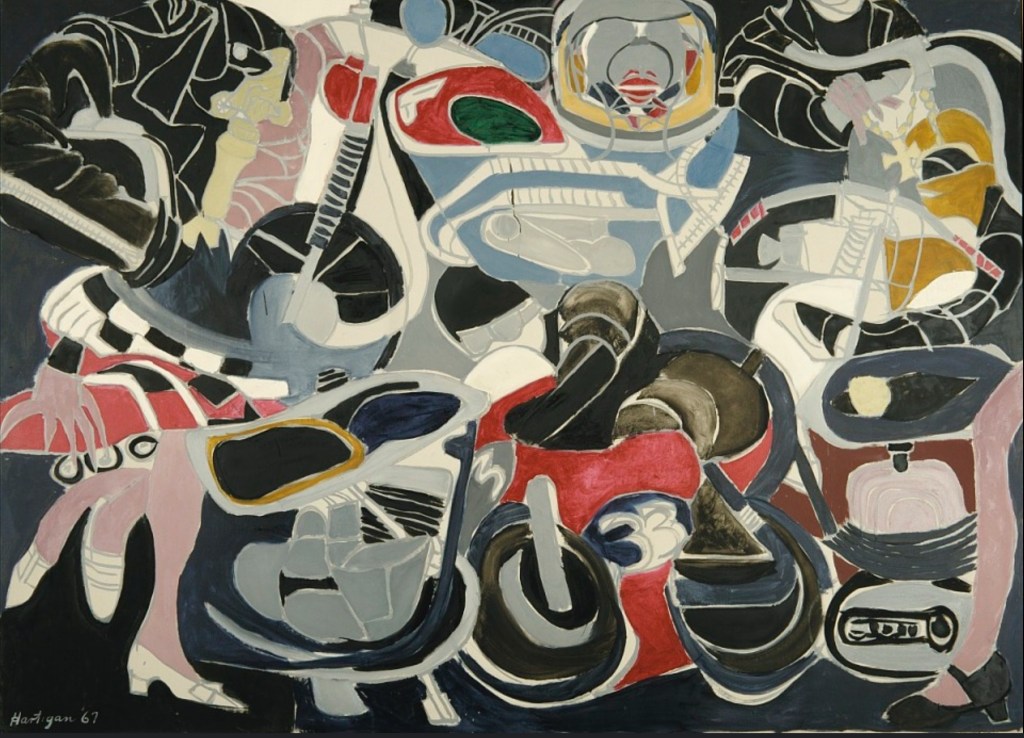
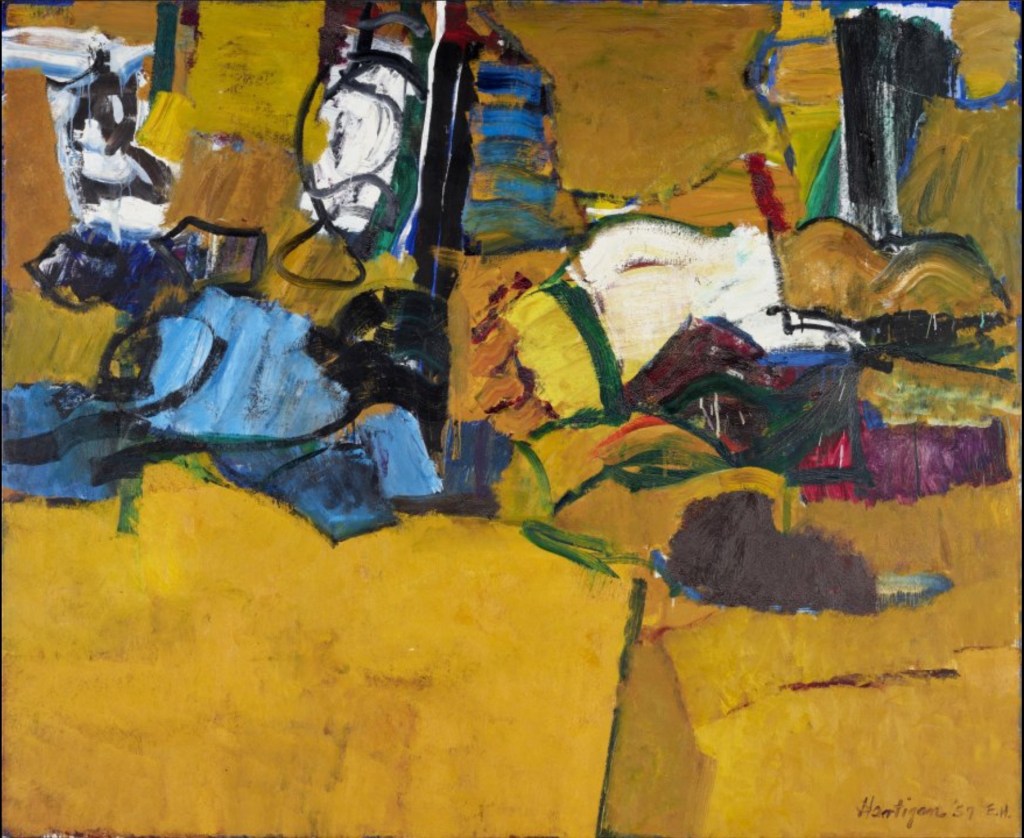
support: 68 1/4 x 83 inches (173.355 x 210.82 cm),Buffalo AKG Art Museum, K1958:2,
© Grace Hartigan Estate

57 1/2 x 48″ , Museum of Modern Art 413.1953, © Grace Hartigan Estate.
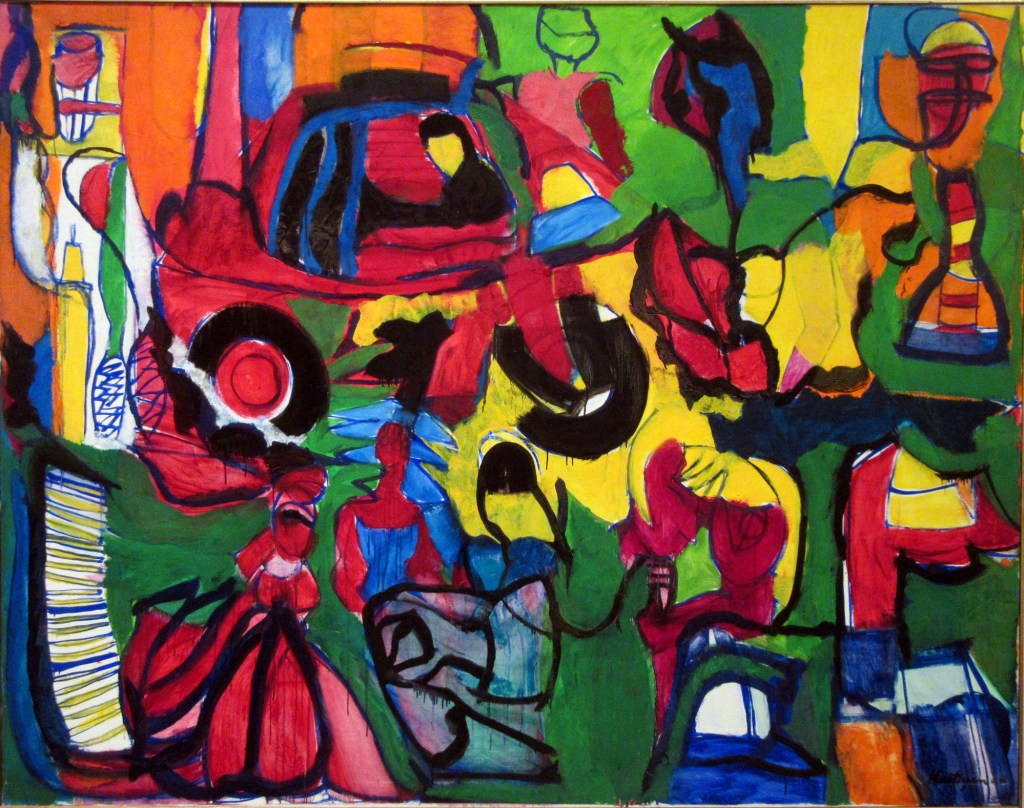
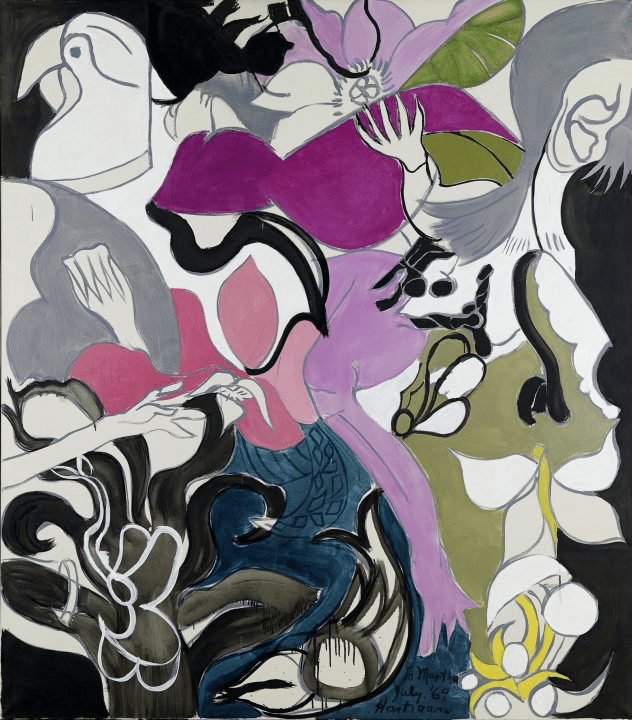
Cover photo credit : The Los Angeles Times, November 22, 2008. Image: © 2008. Los Angeles Times, Artwork: © Estate of Grace Hartigan
 Art Herstory Modern Soul
Leave a comment