Tiny Dots, Big Impacts; Exploring Pointillism Then and Now
Berlin—well, Germany in general—has beautiful parks and green spaces. I’ve been taking full advantage of them during these long summer days (when it’s not spontaneously raining—IYKYK). Whenever I’m lounging in or passing by a park, I can’t help but think how much they resemble pointillist paintings. It’s something in the way the grass has a flat, single swath of color type look to it. Where the ground would turn out to be painted by thousands of tiny green dots if I got down to inspect the individual blades of grass.
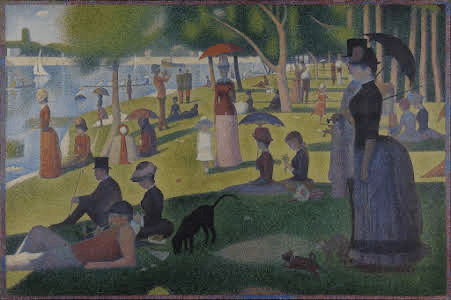
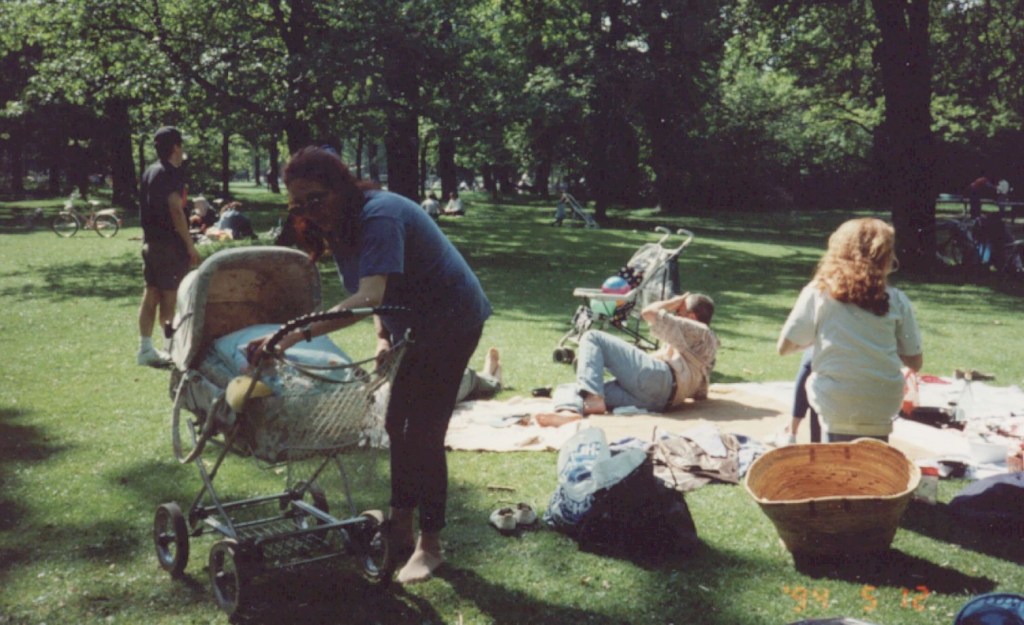
See what I mean? I just can’t unsee the comparison! Pointillism was the signature style of the movement called Neo-Impressionism. You might recognize some of the big names from the movement, which came out of France between 1886 and 1906—like Georges Seurat, Paul Signac, Camille Pissarro, and Maximilian Luce. Yes, you’d be right in noticing they’re all men—there were very few women pointillist painters. Like, actually only one… usually I can dig up some artists I have never heard of but I only found Lucie Cousturier. There was one other artist, Anna Boch, who was the only woman artist of the Neo-Impressionist art group Les XX, but her body of work is predominantly in an impressionistic style. That’s why I’m leaving her out of this post—I personally think she fits better with the Impressionists. A lot of Impressionist painters dabbled in pointillism, but here I wanted to focus on artists whose work is mostly pointillist.
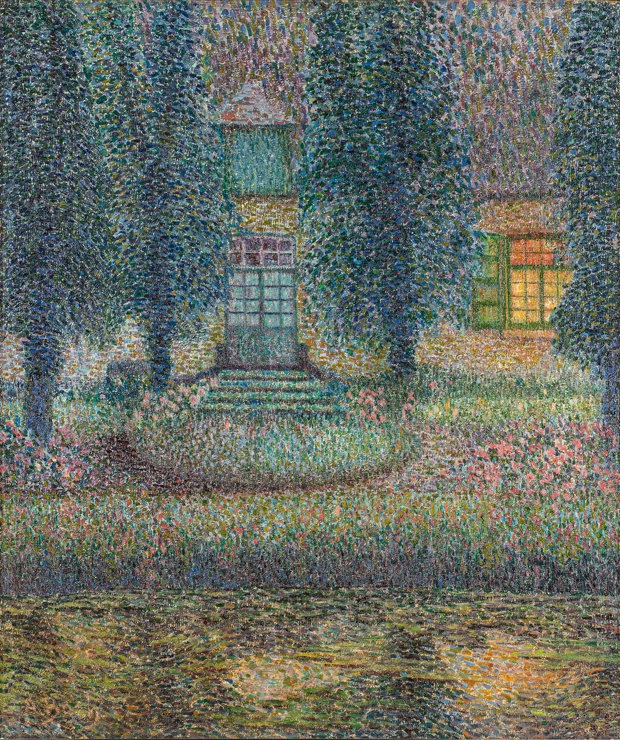
Before we dive into the artists I’ll highlight today, let’s talk about the Neo-Impressionist movement and why pointillism was its key art style.
To Hell With Whimsy, Science Will Lead The Way
Neo-Impressionism was actually a revolt against its predecessor, Impressionism. The founders, Georges Seurat and Paul Signac wanted to take painting away from the intuitive approach to light and color and move it towards the scientific. In other words, they were obsessed with color theory! Their techniques ultimately led to how we perceive colors on our screens today as many small pure colored (RGB or CMYK) pixels close together!
The key to Neo-Impressionist Art was that colors weren’t mixed on the palette. Instead, dabs, strokes and dots of pure pigment were placed next to or on top of one another to bring about the illusion of mixed color. Pure pigments included violet, blue, green, yellow, orange and red. As a rule, these pigments could only be mixed with white, and on the canvas would primarily be placed with neighboring colors from the color wheel (e.g., yellow with orange, or red with purple). Complementary color placement was to be mostly avoided as this would lead to duller tones — exactly what the Neo-Impressionists wanted to avoid. That dullness happens because mixing complementary colors together creates brown.
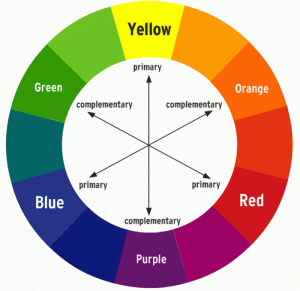
By layering pure pigments and placing them very close to one another, you get a final color that looks much brighter from a distance. The point of the Neo-Impressionist style — properly called divisionism but popularly termed pointillism — was to see the work from afar. The illusion was that the scene was made up of hundreds of tiny strokes or dots, but from afar it looked like one unified mass of color. This new approach to color theory was made possible by the rise of synthetic pigments, which weren’t common before the 19th century. Colors such as chrome yellow (1797), cobalt blue (1803), cadmium orange (1820s), French ultramarine (1826) and manganese violet (1860s). With these new colors artists could have a wider variety of pure pigments to choose from than artists of earlier times who were stuck with naturally derived pigments.
While many Neo-Impressionists used pointillist technique to paint more realistic landscapes and scenes of everyday life, some artists more fully embraced the dot-like aesthetic—keeping the dots separate and noticeable. You’ll see examples of both artists from the original movement and modern artists working in a pointillist style!
Lucie Cousturier 1876 – 1925 | Paris, France
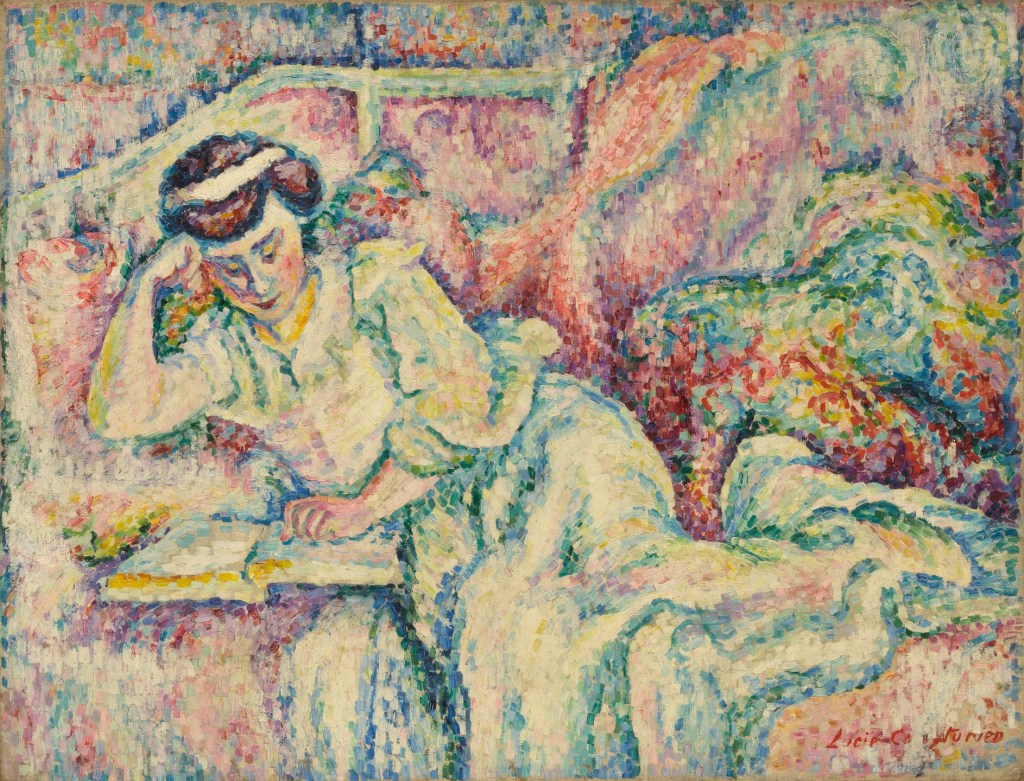
In 1960, the Museum of Modern Art received a painting as a gift from another gallery. It sat in storage for decades—until 2024, when it was finally put on public view. The piece? Woman Reading (1907) by Lucie Cousturier. The invisibility of this piece may lead you to believe she wasn’t a major figure in Neo-Impressionism, but this is far from the truth. In fact, she was a very talented artist and very popular in the Parisian art scene during the late 19th and early 20th centuries. She was also a prolific art collector. At one point, she even owned Seurat’s magnum opus, A Sunday on La Grande Jatte (the one shown above)!
The subject of Woman Reading is all too familiar for women artists of the Neo-Impressionist (and Impressionist) movement. A woman lounging while reading a book… a symbol of women’s grasp for intellectual achievement, growth and validation. Yet in this divisionist style, the woman reading here seems just on the edge of evaporating. As if she’s fighting to stay relevant. Beautiful. Important. Seen…
A striking parallel—inviting us to see the similarity between pointillism and women’s ongoing struggle to be seen and recognized throughout history.
Yvonne Canu 1921 – 2008
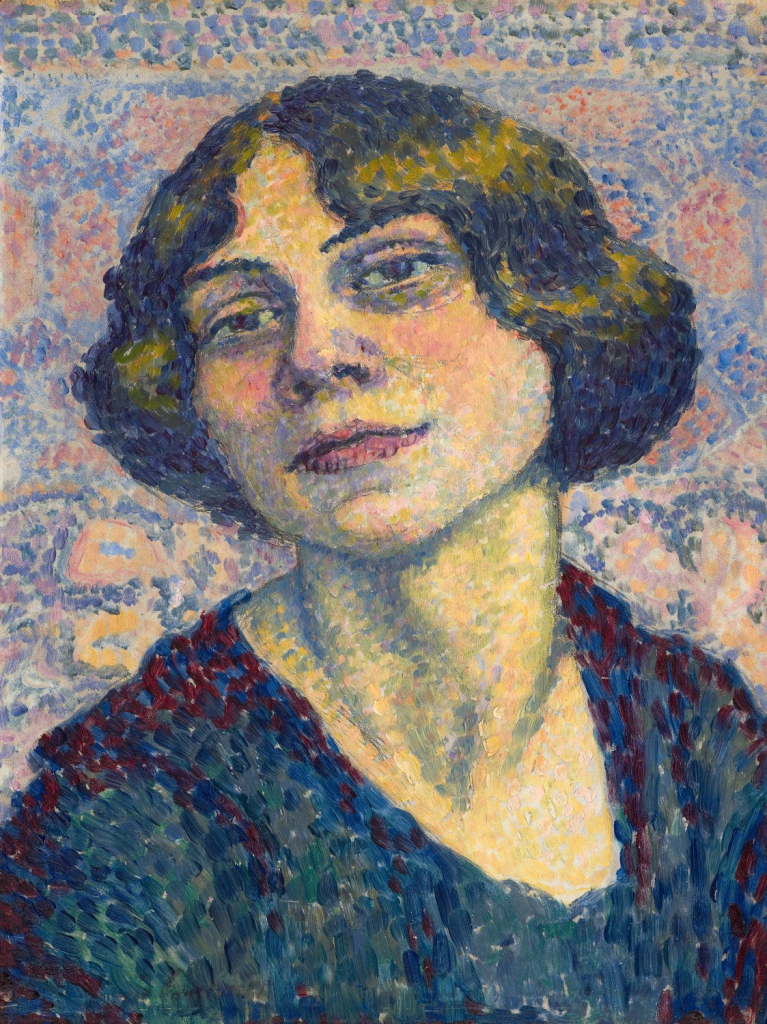
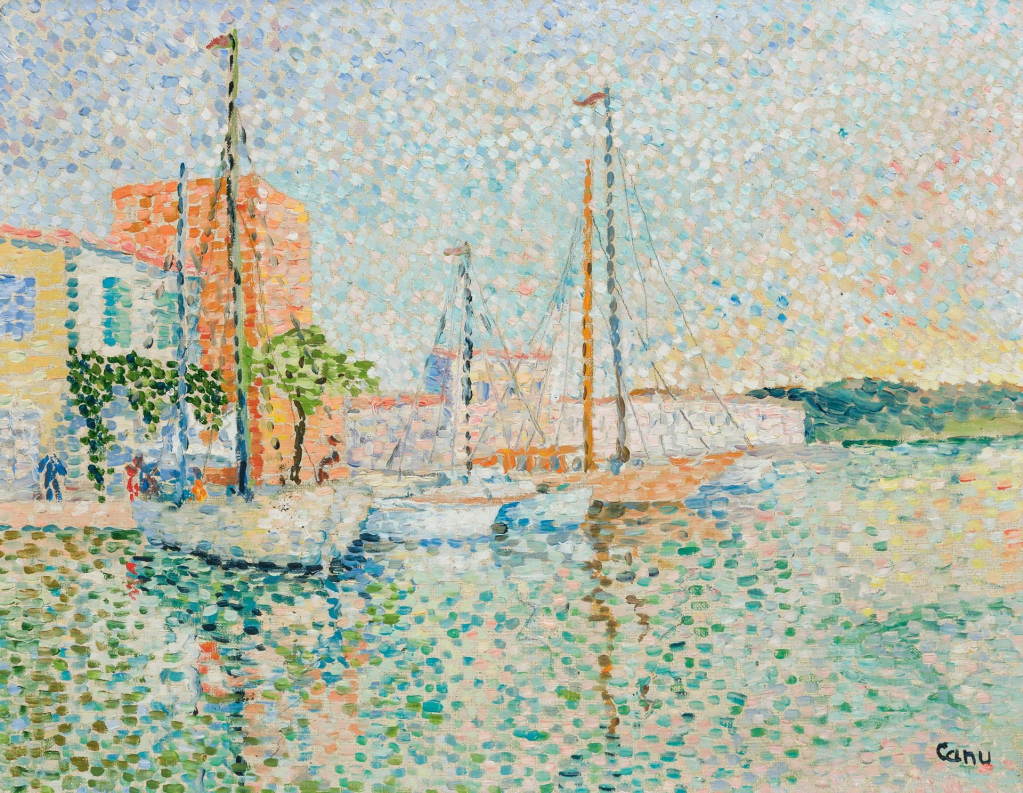
While Yvonne Canu was born well after the end of Neo-Impressionist movement, through her art education she became heavily influenced by Seurat and devoted herself to the divisionist style for the remainder of her career.
Canu studied at the École des Arts Décoratifs in Paris during her college years, but when WWII began, she returned to Morocco and put her studies on hold. Throughout the war she worked as a military nurse and when the war ended she joined the Montmartre group of artists. This group introduced her to plein air painting—that is, painting outdoors—and you’ll find that most of her work reflects scenes of life outdoors. Her biggest inspiration was Seurat and namely his work Sunday on Le Grande Jatte. After seeing his work, she shifted her practice to focus on pointillist techniques and made them her own. She eventually moved to St. Tropez, where she continued her work. Many artists throughout history have been drawn to St. Tropez, finding inspiration in its sunny weather and vibrant culture.
When you compare Canu’s work to Cousturier’s above, you’ll probably notice Canu’s palette is much brighter. That’s partly because Cousturier’s paintings have aged over time, but also because Canu had access to a more modern palette. Canu’s paintings make me want to jump right into them and go on holiday — don’t you agree?
There are more beautiful examples of her work on Shannon’s Fine Art Auctioneers website — go check them out!
Gwen O’Neil 1992 – Present |United States
Modern art—especially abstract art—is always unique and fascinating. But we can often find comparisons and inspiration in modern works, making historical connections to pieces from the past. I find myself connecting Gwen O’Neils work to the few female pointillists in history. Still inspired by nature and using individual marks to build a whole, Gwen’s work feels similar to the pieces we’ve seen so far. She was originally a landscape photographer but turned to painting. Using color, mark-making and form, O’Neil creates vibrant, fluid swirls and curves of color across the canvass. I’m a sucker for beautiful color combinations and Gwen’s work definitely scratches all the right itches. Her tantalizing shapes, with rich colors I just want to wrap myself in, embrace all the best parts of abstraction.
O’Neil earned a BFA from Savannah College of Art and Design in 2015 and since then has been creating beautiful bodies of work. Check them out here (copyrights, sorry y’all)!
Ilhwa Kim 1967 – Present | South Korea
Ilhwa Kim… where do I even begin. Her art and technique are like nothing I have ever seen. She’s a 3-D abstract artist whose practice involves hand-dyeing tens of thousands of pieces of mulberry paper, rolling them into shapes, and then displaying them together as one cohesive work. She calls these handmade rolls ‘seeds’.
“I build up and break down painted surface waves using my own “paper seed” units, consisting of bold, densely juxtaposed hand-dyed colors. This creates a very subtle interplay between the paper’s architectural structure – these elements never remain static.”
They remind me of microscopic ecosystems—tiny worlds swirling just beyond the eye’s reach until we magnify them. Blooming with life, color and movement. Her works feel nothing short of miraculous. See for yourself:
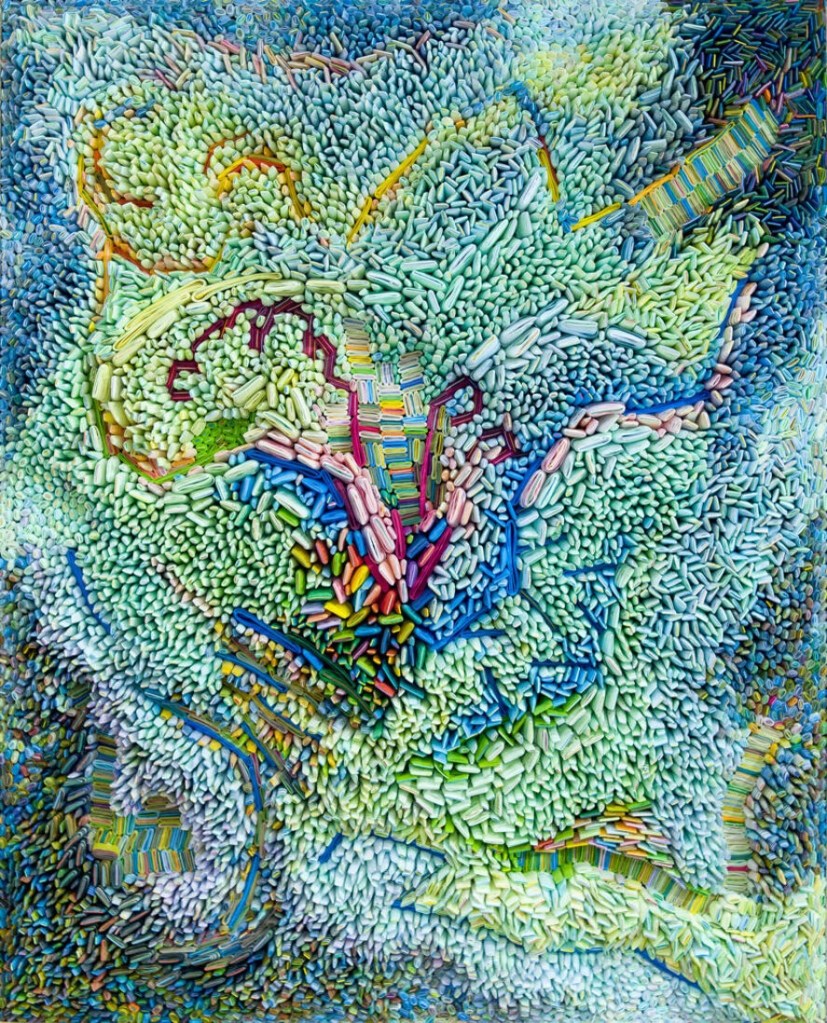
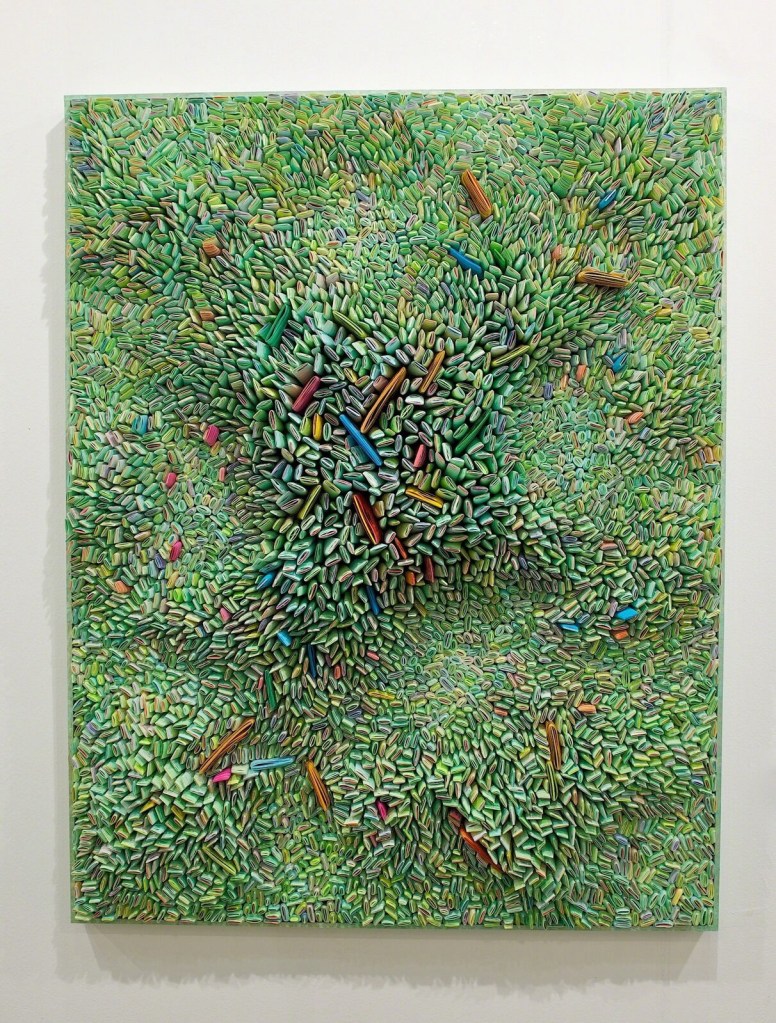
46 9/10 × 36 3/5 × 7 1/2 in | 119 × 93 × 19 cm. Artsy.net
From the delicate dots of Neo-Impressionists like Lucie Cousturier to the vibrant swirls of Gwen O’Neil and the mesmerizing 3-D worlds of Ilhwa Kim, it’s clear that the spirit of pointillism lives on.
If this journey through dots, colors, and tiny seeds inspired you, I’d love to hear your thoughts! Which artist or technique resonated with you the most? Drop a comment below, share this post with a friend who loves art, or even try your hand at creating your own pointillist-inspired piece. Let’s keep the conversation—and creativity—flowing!
🩷 Thanks for reading 🩷
Works Cited
“Anna Boch.” Simonis & Buunk, https://www.simonis-buunk.de/kuenstler/rosalie-anna-anna-boch/kunstwerke-zu-verkaufen/3583/.
“Lucie Cousturier.” Aware Women Artists, https://awarewomenartists.com/en/artiste/lucie-cousturier/.
“Pointillism.” Art in Context, https://artincontext.org/pointillism/.
Gwen O’Neil. Official Website, http://www.gwenoneil.com/.
Seurat, Georges. A Sunday on La Grande Jatte. Google Arts & Culture, https://artsandculture.google.com/asset/a-sunday-on-la-grande-jatte/twGyqq52R-lYpA?hl=en-GB.
“Meet the Artists Reinventing Pointillism, a 19th-Century Technique.” Artsy, https://www.artsy.net/article/artsy-editorial-meet-artists-reinventing-pointillism-19th-century-technique.
Seurat, Georges. A Sunday on La Grande Jatte, 1884. Art Institute of Chicago, https://www.artic.edu/artworks/27992/a-sunday-on-la-grande-jatte-1884.
“Introduction to Neo-Impressionism, Part I.” Smarthistory, https://smarthistory.org/introduction-to-neo-impressionism-part-i/.
“Neo-Impressionism.” Encyclopedia Britannica, https://www.britannica.com/art/Neo-Impressionism.
“Lucie Cousturier’s Woman Reading.” Museum of Modern Art Magazine, https://www.moma.org/magazine/articles/1100.
Ilhwa Kim. Official Website, https://www.ilhwakim.com/news.}


 Art Herstory Modern Soul
Leave a reply to Jeff Cancel reply