More Than Pretty Things: The Still Life
“Flowers will be from my garden and the food will be things I’ve either grown or people have brought to me. It’s a universal thing to want to depict what’s around you, what makes sense to you and what’s meaningful.” Kiata Mason
Does anyone else deeply appreciate a beautifully set table? I definitely do. Think back to a time you got together with friends or family and had a dinner party; see in your minds eye each stage of the table: the beginning before people have started dining and upsetting the immaculate table settings and beautifully roasted casseroles, the middle where people have spilled glasses of wine, sauce has dripped off a ladle or two onto the napkins strewn across the table. Then at the end, when the aftermath covers the table, the crumbs and empty plates the only hint at the delights that had been devoured and the joy that flowed.
A table may be a modest piece of furniture, essentially a slab of wood and four legs, but what sits atop it can tell a lot about the person or persons who have set it and give the table a soul of its own. In this same way, still life paintings have been used for centuries to pictorially provide these exact hints about the goings on behind the scenes of a set table. They are mysterious portals on canvas, made for the observer to imagine and deduce what is going on “off-stage”.
Let’s dive in and take a look and this under appreciated, yet institutionally important genre of art.
The Masters – 16th & 17th Centuries
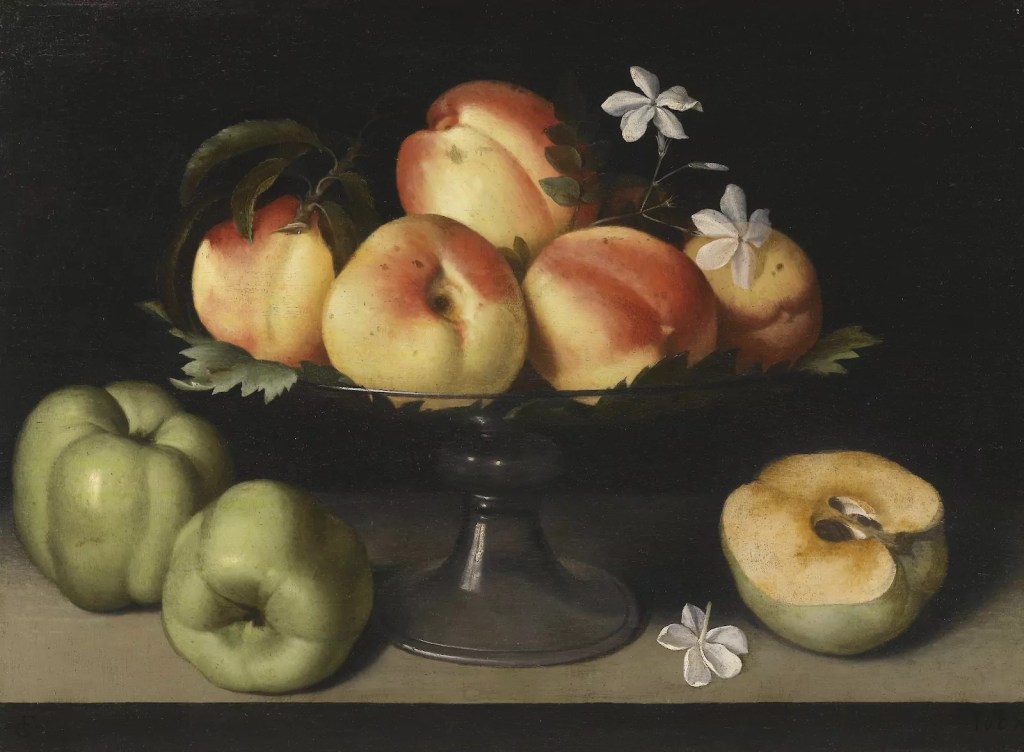
Before we dive into the Dutch Masters we should start with the artist considered to be perhaps the very first women to specialize in still life painting; the Italian artist Fede Galizia (1578-1630). She started painting very young and was renowned for her close-up attention to detail. By the time she was twenty years old she had already established loyal clientele and was internationally recognized for her skills. I love the browning quince in the corner of her painting along with the fallen jasmine bud. It’s mysterious yet wholly normal, making the painting feel real instead of staged. The rendering of the peaches? It’s classic baroque but screams modern day peach ring gummies, no?
During the 16th and 17th centuries still lifes were in high demand and the best known still life masters came from the Netherlands, hence why we refer to these artists collectively as the Dutch Masters. The Dutch East India Trading Company gave the Dutch upper and middle class access to exotic foods, textiles, spices, animals etc as trade started flowing in from around the world. Wealthy patrons wanted to document this new found wealth, and so they hired painters to paint proof of their rare collections.
Then, in direct opposition to this extravagance, the church (Protestants in this time) reminded its congregation that wealth and power did nothing but corrupt the soul and in response, many painters started painting a still life sub genre known as Vanitas. Vanitas is Latin for vanity in the sense of emptiness, or hollow action. These paintings depict wealth too, yes, but with hidden symbolism about the perils of wealth and the transience of life. See below the skull and the sand clock in van Oosterwijk’s work. These motifs symbolize death, of course, but also the limited time we have on Earth. Paired with the globe, the books, and the quill, I believe the message here is that our time is better spent learning, creating, and bettering oneself rather than obsessing over the collection of wealth. A prominent message in today’s world, no?
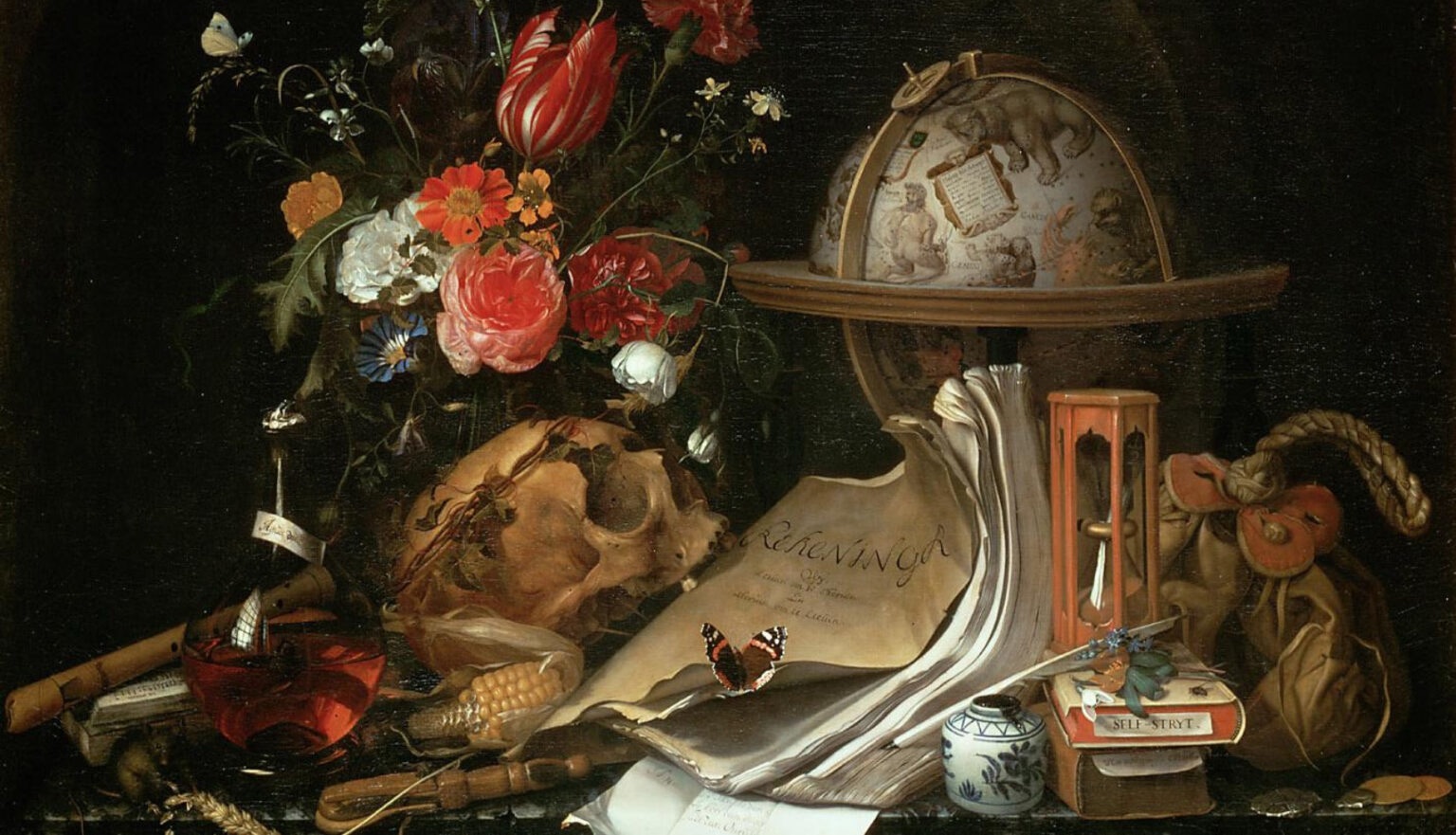
Maria van Oosterwijck, Vanitas Still Life, 1668, oil on canvas, Kunsthistorisches Museum. Vienna, Austria. Image is in the public domain.
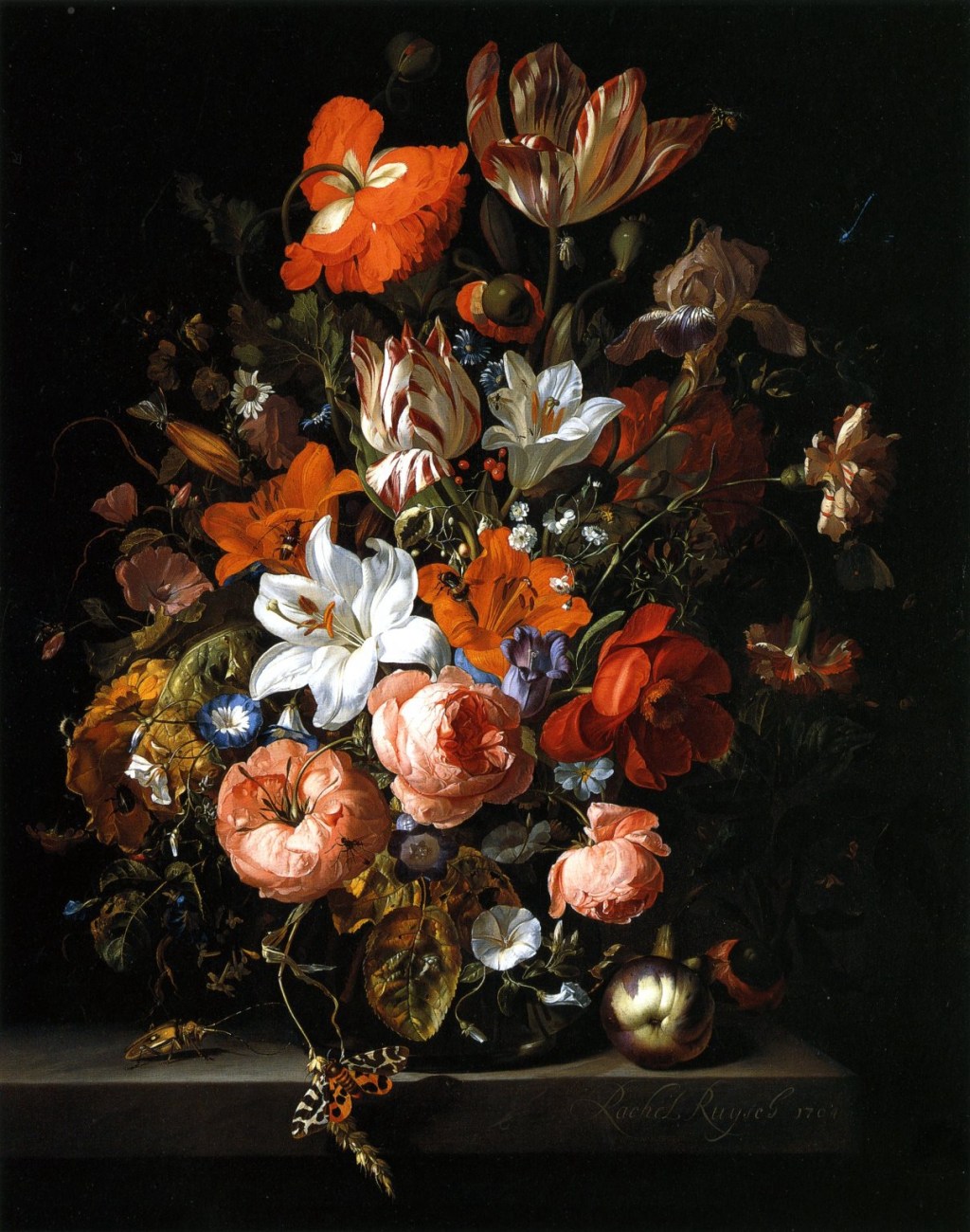
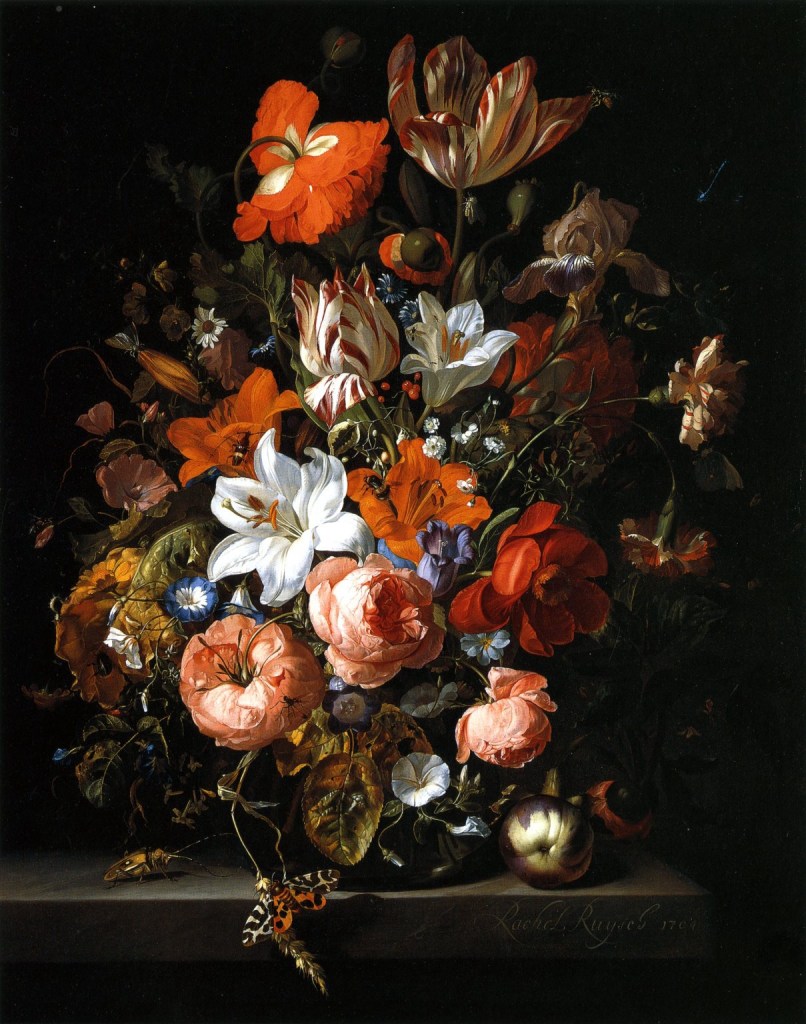
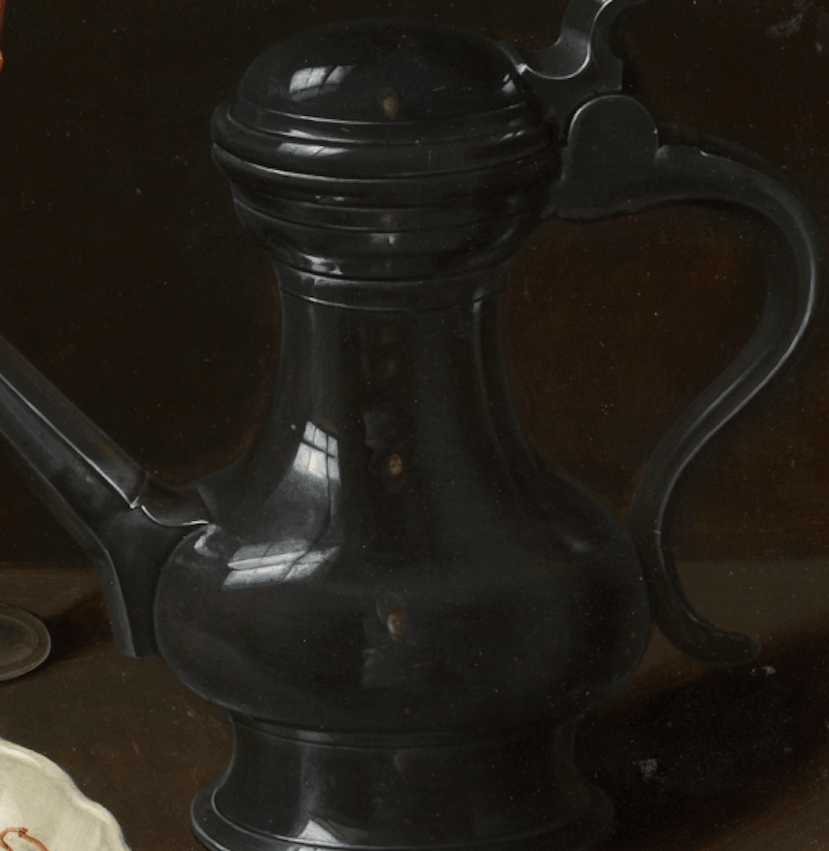
The artist of the floral work up above, Rachel Ruysch, became one of the highest paid artists of her time and the first woman to be inducted into the artist’s guild in the Hague. She was incredibly successful, but as with most women artists fell out of the history books. The same can be said for the artist of the work below as well, Clara Peters. In their floral paintings they both focused on the exotic flowers that were often collected by wealthy patrons. If you look closely, you can see that Peters even painted her own reflection not only into the oil pitcher but also into each facet of the golden chalice! Peters was known for adding herself into her paintings using reflections.
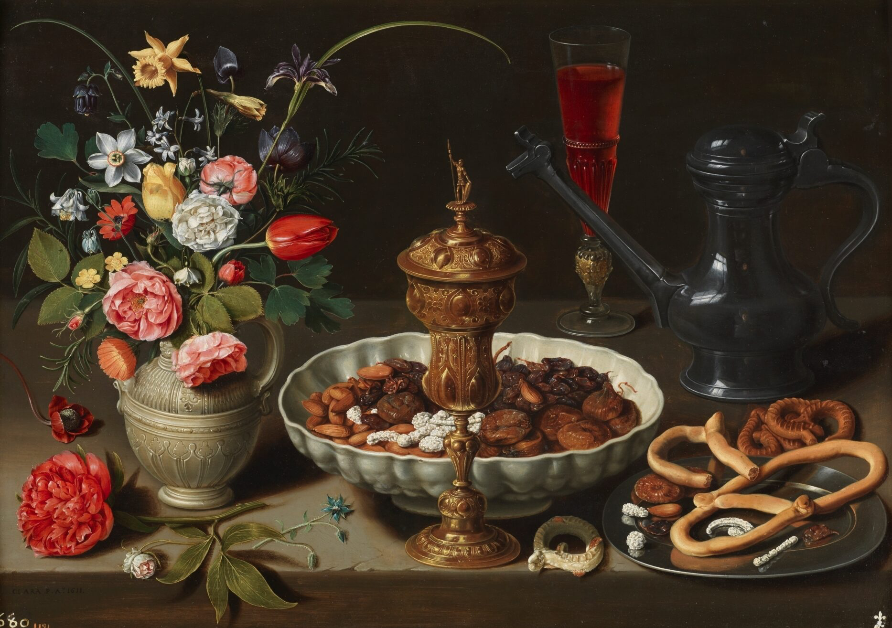
Do you find anything about Peters’ and Ruysch’s paintings a bit puzzling? If there are any florists or green-thumbs out there you may have caught it. The bouquets on display here could never have existed in real life! All these flowers bloom at different times of the year! For instance, in Ruysch’s painting those lovely little morning glory’s are only open in the mornings, they would have died or closed if snipped for the purpose of being posed for a painting. Or, as shown in both paintings, Tulips bloom in spring where roses and poppies bloom in summer!
What is also fascinating about these florals is that they are painted entirely from memory or from the artists’ own botanical and entomological studies. In fact, Ruysch was well known for her scientific drawings and her renderings of insects in her paintings. Any entomologists out there able to identify any of the bugs in her painting; let me know in the comments below! Every bug holds symbolism as well; what messages are these creepy crawlies sending to you?
The In-Between Still Life Queen – middle 18th Century
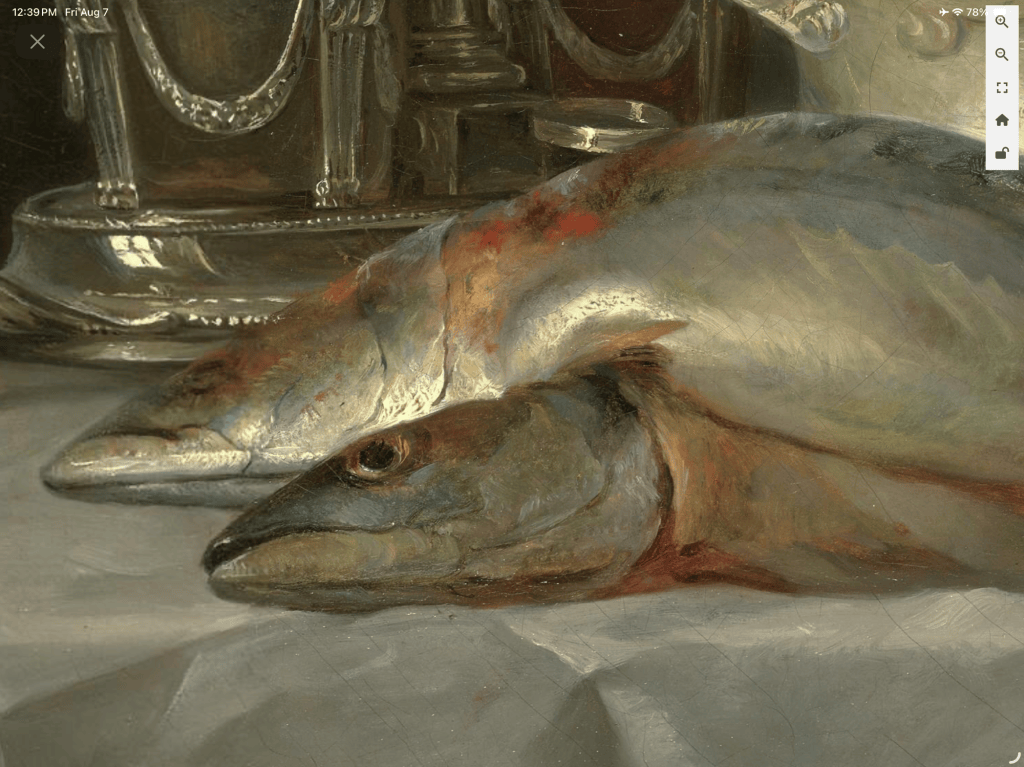
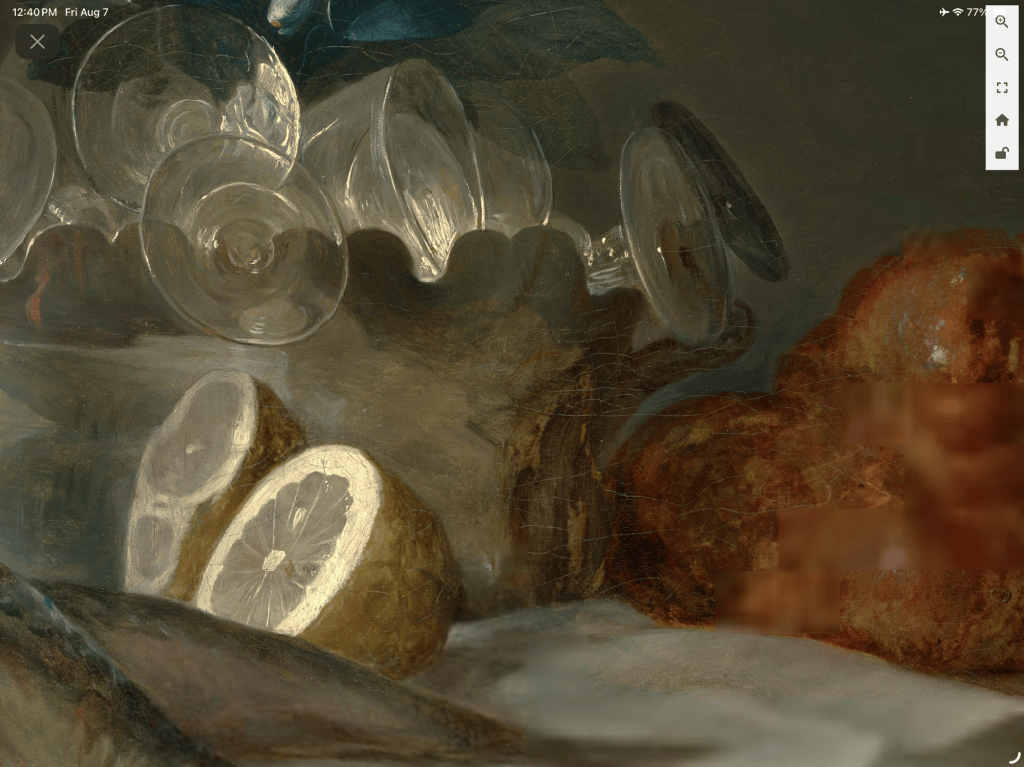
Right before we dive into the 19th, 20th and 21st centuries let’s take a quick stop and smell the roses (or dead fish…) represented in this next wonderful painters work! Enter in Anne Vallayer-Coster (1744 – 1818), who eventually became Marie Antoinette’s personal painter! The piece you’ll see below was one of my favorites that I came across while researching her. The color palette immediately grabs my attention; while it is somewhat monochrome —using primarily creams, grays and whites — it’s quite ethereal in nature. Somehow while most of the objects are silver toned in some way, they all have their own textural characteristics and pops of color! It’s masterful, is it not?
The pile of wine glasses in the silver verrière look so thin and fragile that it makes me feel like I can hear them tinkling! Is this table that of one of the palace cooks in Versailles preparing for the Queen’s dinner perhaps??
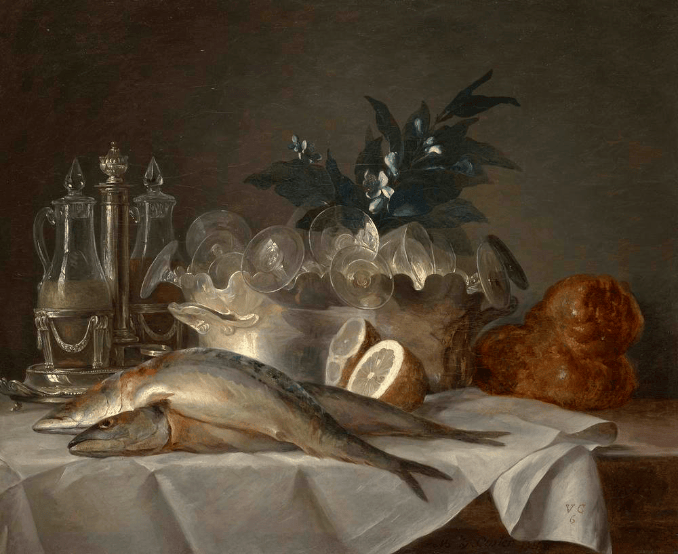
Anne Vallayer-Coster, Still Life with Mackerel, 1787. Oil on canvas, 19 ½ x 24 in. (61 x 49.5 cm). Kimbell Art Museum, Fort Worth, Texas. APg 2019.01, Gift of Sid R. Bass in honor of Kay and Ben Fortson.
Approaching Modern Age – 19th Century
These next two pieces mark a shift towards a more free and creative approach to the still life genre. No longer solely focused on hyper realism, or being solely representational, still lifes start to become a bit more cheeky.
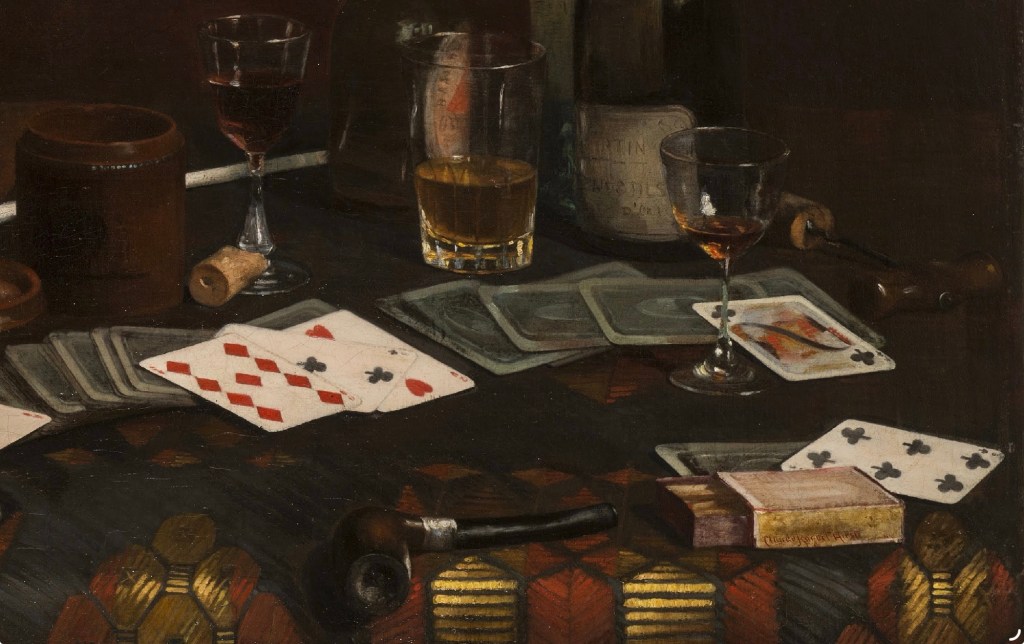
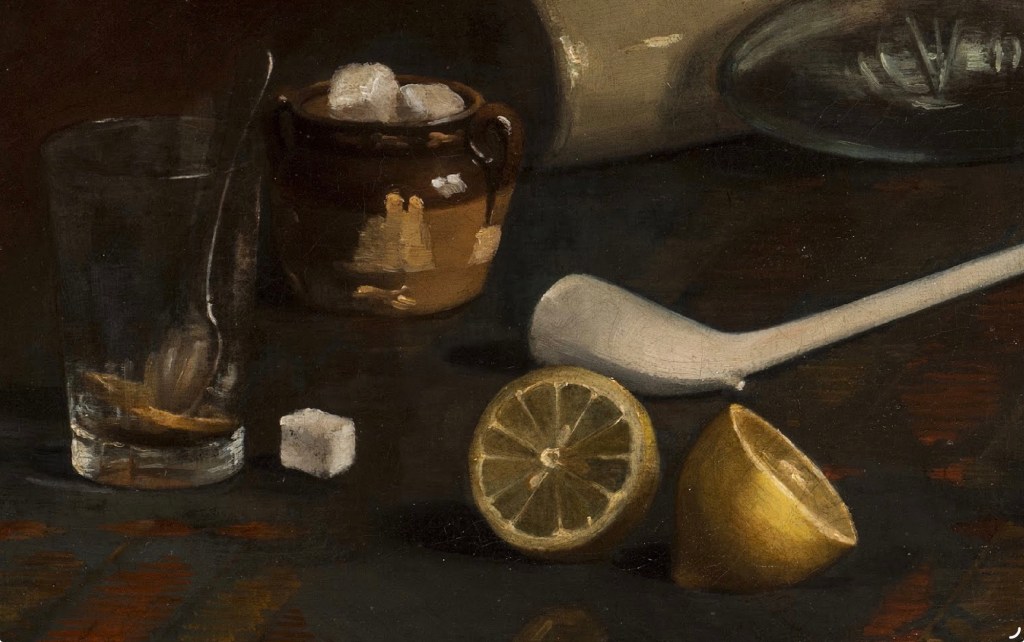
This next painting by Claude Raguet Hirst (1855-1942) depicts a table at a men’s get-together at a Gentlemen’s Club in Chicago. What is interesting is that this trompe l’oeil (French for ‘to deceive the eye’) style painting was very popular in the late 1800’s by male artists, but this club hired her to paint it for them and paint it she did. You’ll notice immediately the painting’s air of masculinity in the brooding colors, the gambling cards, the alcohol, and the strange random golf club… But, what the men seemed to have failed to recognize is Hirst’s criticism of male vices that many women dealt with at the time such as gambling, and alcoholism. There are four bottles of alcohol, with at least two already empty and laying on the table. Another is actively being drank, peep the wine opener with the cork still attached. There is also the glass with the spoon in it and the sugar cube and lemon next to it; this most likely depicts the drinking of absinthe which at this time was a dangerous and often lethal liquor. You can almost sense that the men had gone for a smoke perhaps and Hirst snuck in to capture this intimate and telling snapshot of this ‘gentlemen’s only’ table, pulling up a chair where usually she’d not be given one. We love to see a woman in a male dominated field!
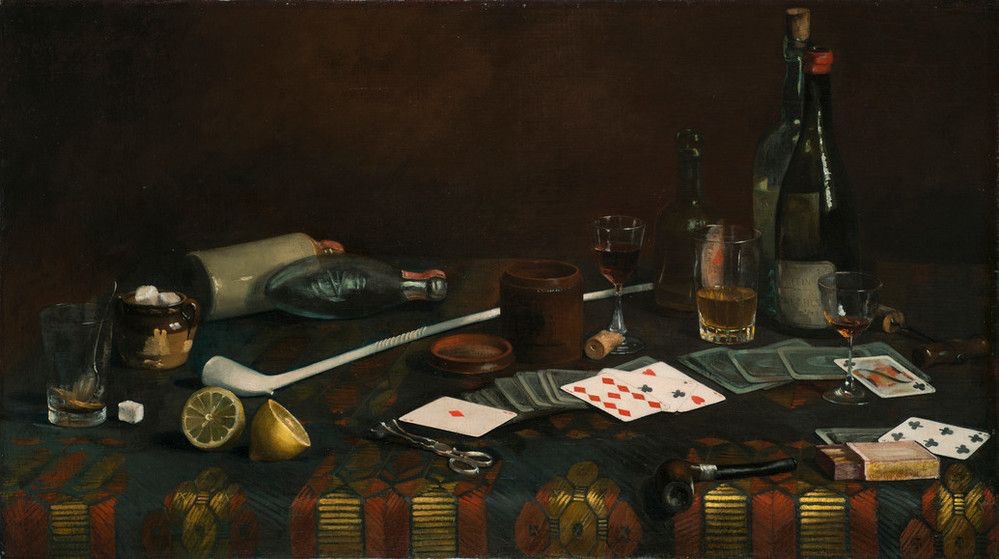
Claude Raguet Hirst, A Gentleman’s Table, after 1890; Oil on canvas, 18 x 32 in.; National Museum of Women in the Arts, Gift of Wallace and Wilhelmina Holladay; Photo by Lee Stalsworth
The next painting at first glance may seem no different than the work from the old masters but there’s a single element that made me smile as soon as I saw it! It lights up the piece in a sweet and slightly silly way. See if you have the same reaction.
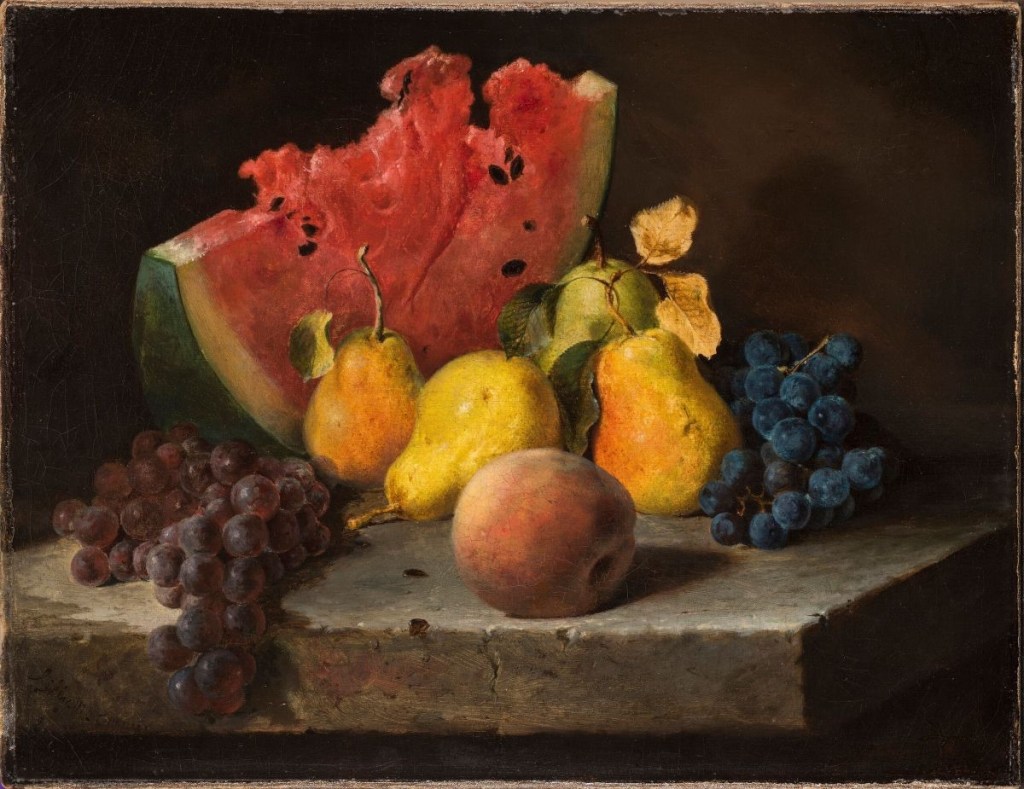
Lilly Martin Spencer, Still Life with Watermelon, Pears and Grapes, ca. 1859; Oil on canvas, 13 1/8 x 17 1/4 in.; National Museum of Women in the Arts, Gift of Wallace and Wilhelmina Holladay; Photo by Lee Stalsworth
The Watermelon! Lilly Martin Spencer (1822-1902) loved painting everyday scenes from American life. The slice of watermelon with a big chunk bitten right out of it could be a snapshot of an 1860’s Fourth of July party could it not?! With the seeds fallen onto the table perhaps she couldn’t help herself and chomped a chunk right off and then leaned back and continued the painting!
Modernity 20th – 21st Centuries
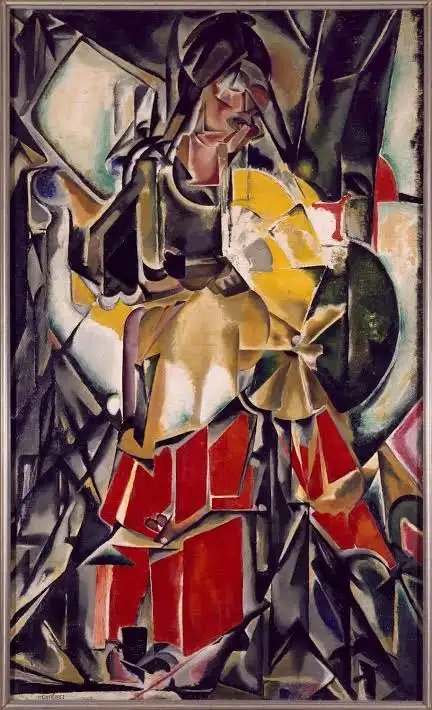
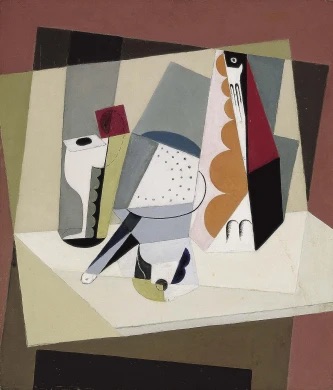
So here we are, congrats to you, you’ve made it to the modern day still life! I must say I think they may be my favorites but you’ll have to decide for yourself. By now the still life has come a long, long way and I think you’ll agree. We’ll start in 1919 with a cubist work by Spanish painter María Blanchard (1881-1932). Diego Rivera said, in a backhanded compliment, that her paintings were “Cubism’s finest works, apart from our master Picasso”. He almost got it right. When it comes to Picasso (and a large swath of other famous male artists) we should should stop separating the artist from the art, #cancelpicasso. We should instead start to study and immortalize artists like María Blanchard. I’ll deviate from the still lifes for just a second because I have serious beef with Picasso’s memorialized fame (click to enlarge the images). Check out the comparison between their works and decide for yourself if you agree with Rivera, or if his statement was a classic case of “the boys’ club”.
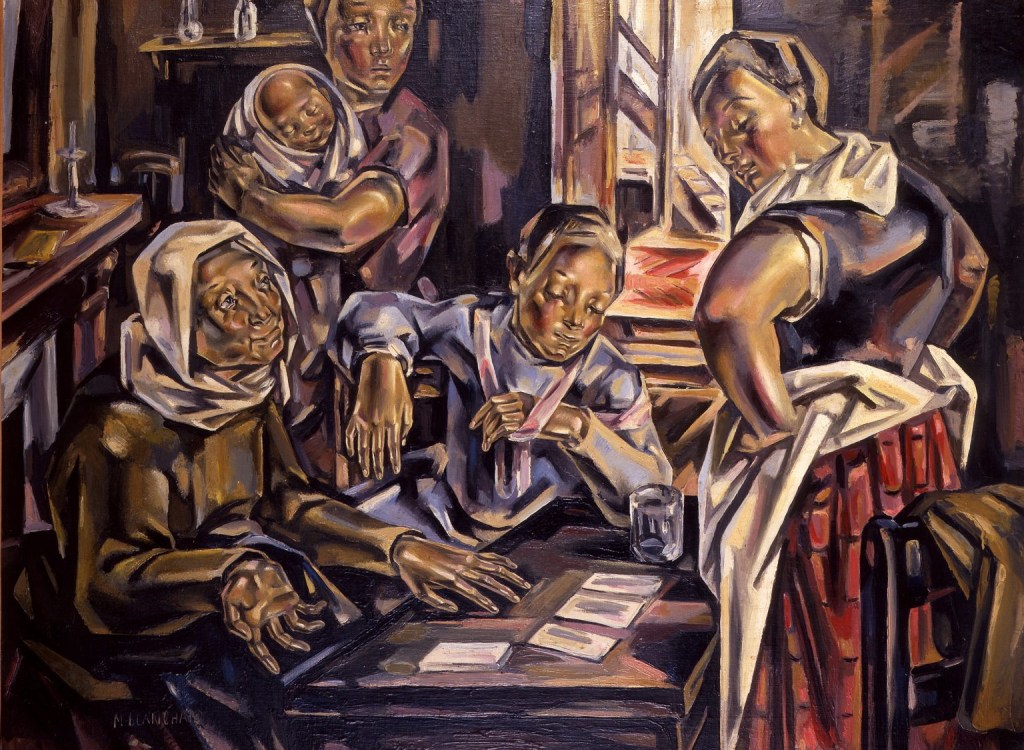
Maria Blanchard, The Fortune-Teller (1924-25). Photo: © Studio Monique Bernaz, Geneva.
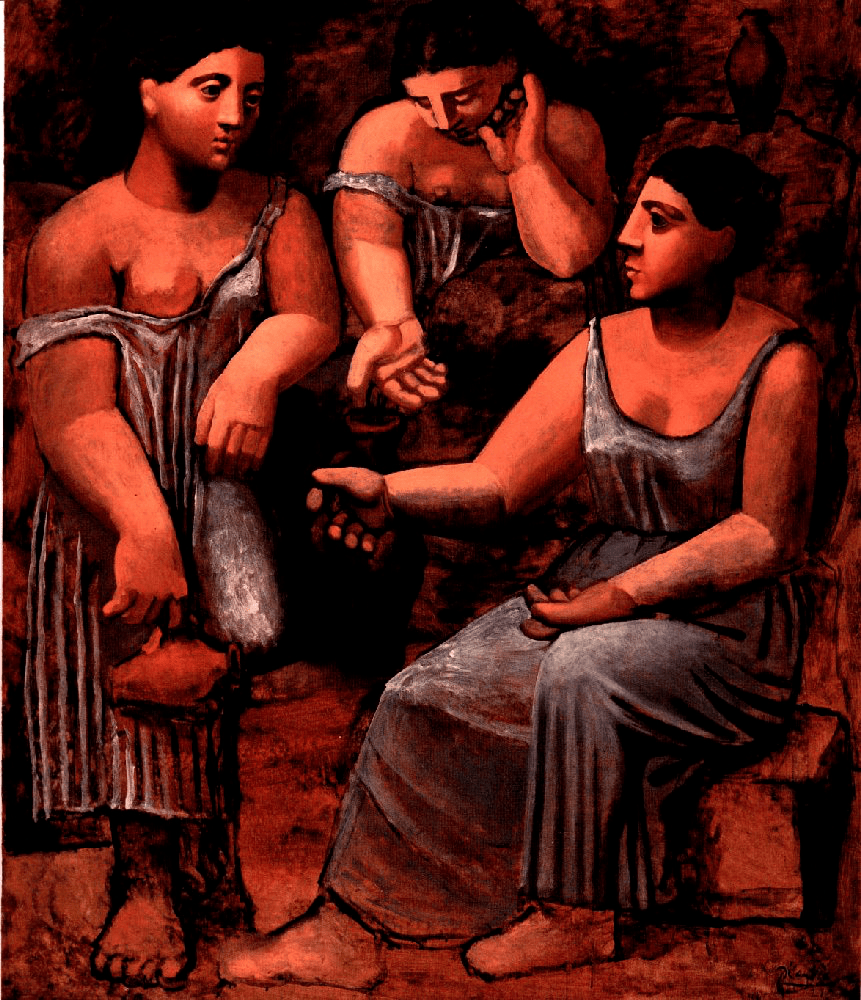
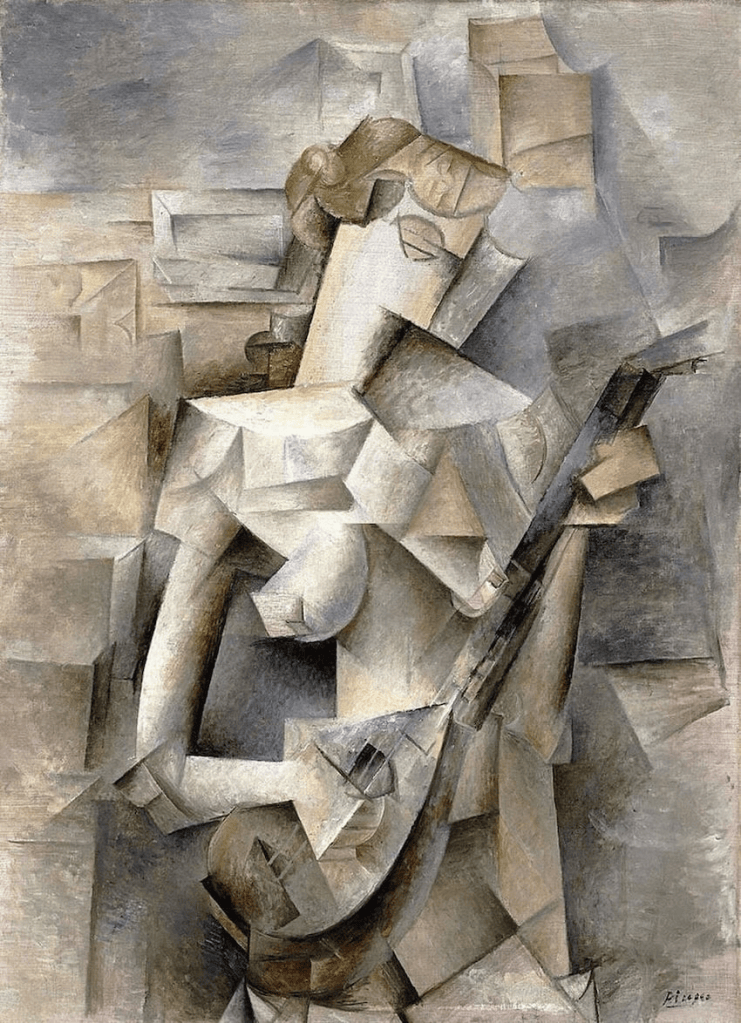
Paris, late spring 1910
Oil on canvas, 39 1/2 x 29″ (100.3 x 73.6 cm). © 2026 Estate of Pablo Picasso / Artists Rights Society (ARS), New York. MOMA, objects number 966.1979.
Anyway, back to our scheduled programming: the still life! I truly can’t say what Blanchard painted here in this next piece, and she doesn’t tell us, but I can say what I see in it: a paper towel roll, a frying pan, a fish and a loaf of bread. I know there definitely is not a paper towel roll because they weren’t accessible to the public in 1919, but I see it nonetheless. What do you see?
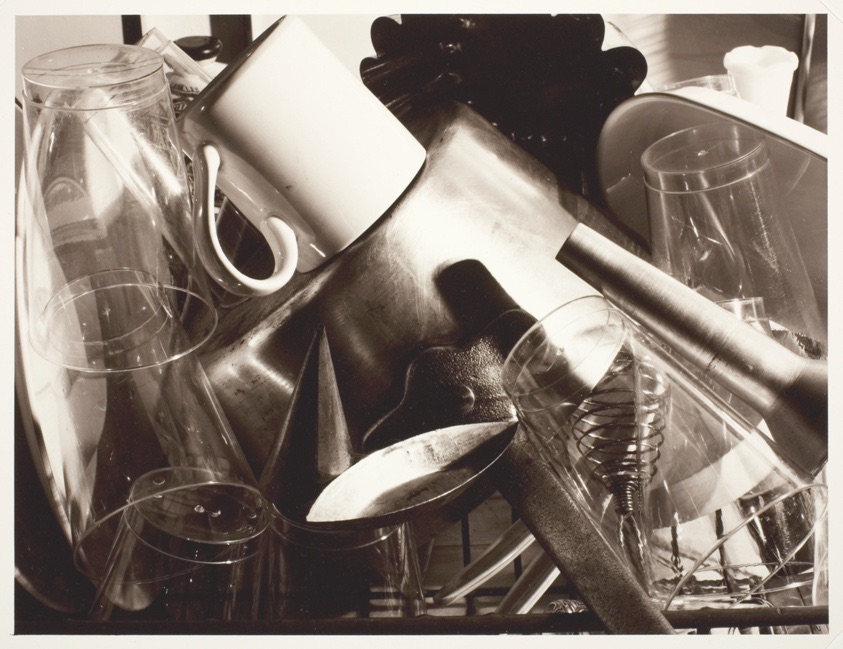
Next up we have photographers Jan Groover (1943 – 2012) and Maisie Cousins (1992 – present). Both artists use photography to capture still lifes representing the unglamorous parts of being a woman. First we look at Jan Groover’s Untitled work from 1982. A black and white gelatin silver print of a dish rack piled high with dishes, it first exhibits a sense of Hollywood glamour with the play of silver toned light and shadow, but the underlying message is less beautiful. It invites us instead to contemplate the weight of home based, daily labor placed disproportionately onto women’s shoulders both then and still today.
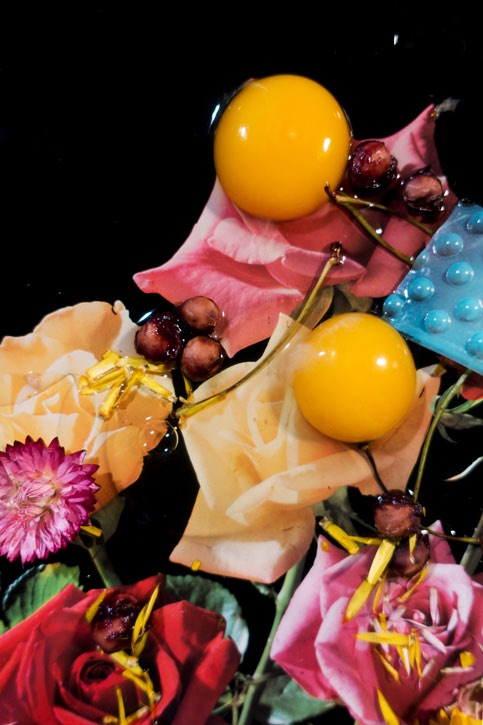
The second photograph we’ll look at is by artist Maisie Cousins. Known for sweetly colored, visceral photographs of female bodies and female life, she blurs the boarders between sensuality and savageness. The work Breakfast (2017), to me, is a representation of the pressure on women to be healthy, skinny, beautiful, fertile and sexually active, while simultaneously sexually protected or just chaste and pure all at the same time. The cognitive dissonance and impossible expectations of being a woman are all wrapped up into one sickly sweet and mildly icky photograph.
You’ll see blooming roses, but also a destroyed daisy sitting in goop from two yellow egg yolks (symbolic of ovaries perhaps or a strict diet of two eggs in the morning to maintain figure?). There are also chewed up cherry pits and a packet of what I think could be representing birth control. A breakfast of 2 egg yolks, handful of cherries and birth control feels similar to the ‘coffee and a cigarette breakfast’ touted to women in the late 20’s by Lucky Strike “reach for a Lucky instead of a sweet”. What do you feel when you look at this photograph?
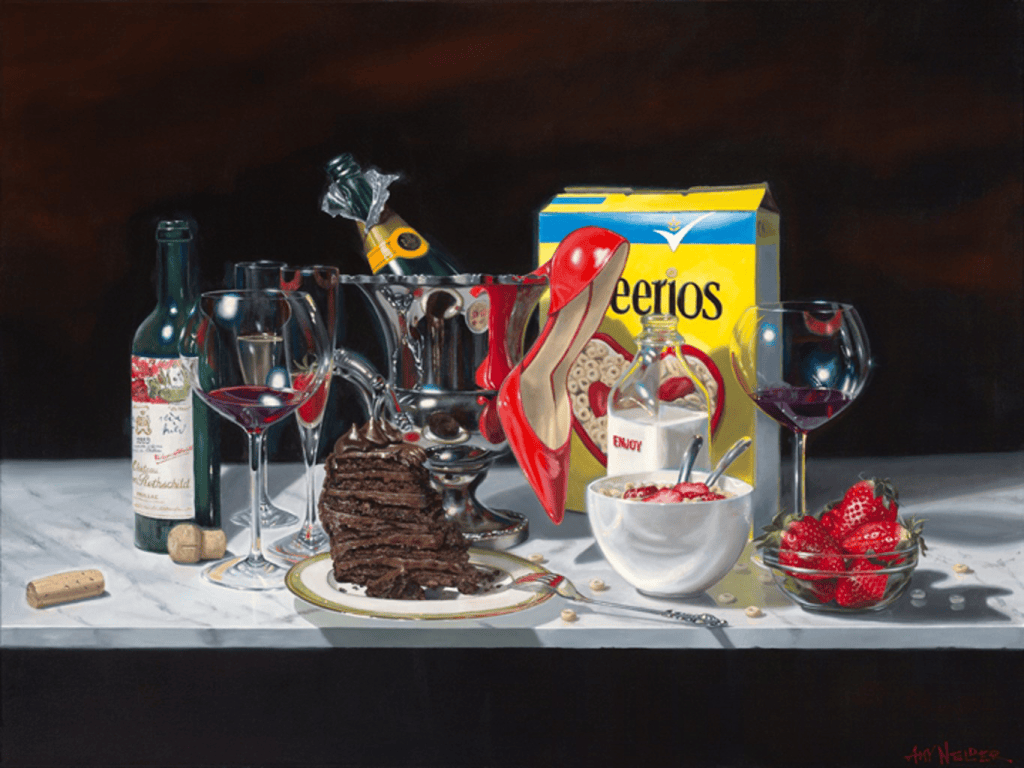
The next work is a painting by artist Amy Nelder (1971-present). She calls her work ‘Pop Trompe L’oeil’ because they are very realistic still lifes that embody modern day pop culture. The piece I’ve chosen to show you is titled 2 A.M. (/75). It looks like the painting of a well thought out girl dinner, or munchies session if you catch my drift. I do find it intriguing that there are two bottles of wine and four glasses but only two have lipstick stains, two spoons in the cereal, and there’s only one red high heel… a late night rendezvous perhaps! There’s definitely more to the story hidden behind this painting for sure!
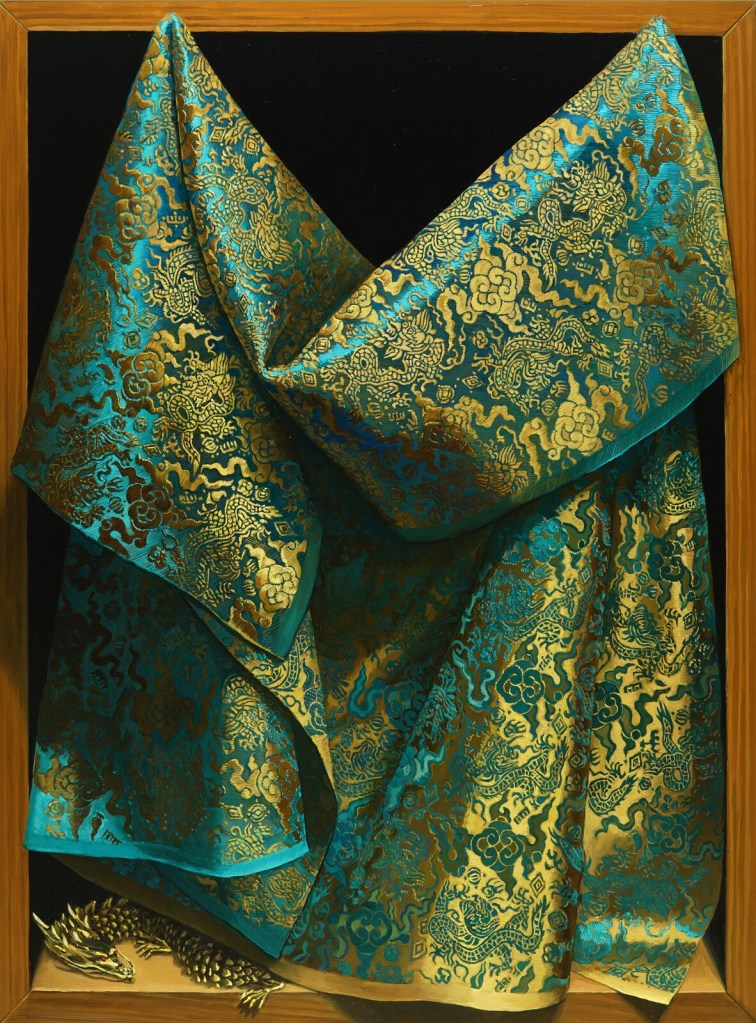
This next still life is another trompe l’oeil style painting but this artist’s specialty is in hyper realistic painting of fabric. Which, because it is an inanimate object, makes it still life adjacent. I chose Leeah Joo’s Parrhasius no. 63, Imugi, because of the insane detail of the silk and crazy optical illusion of the fabric coming out of the frame, but also because of the additional dragon sculpture which brings this painting closer to the realm of still life.
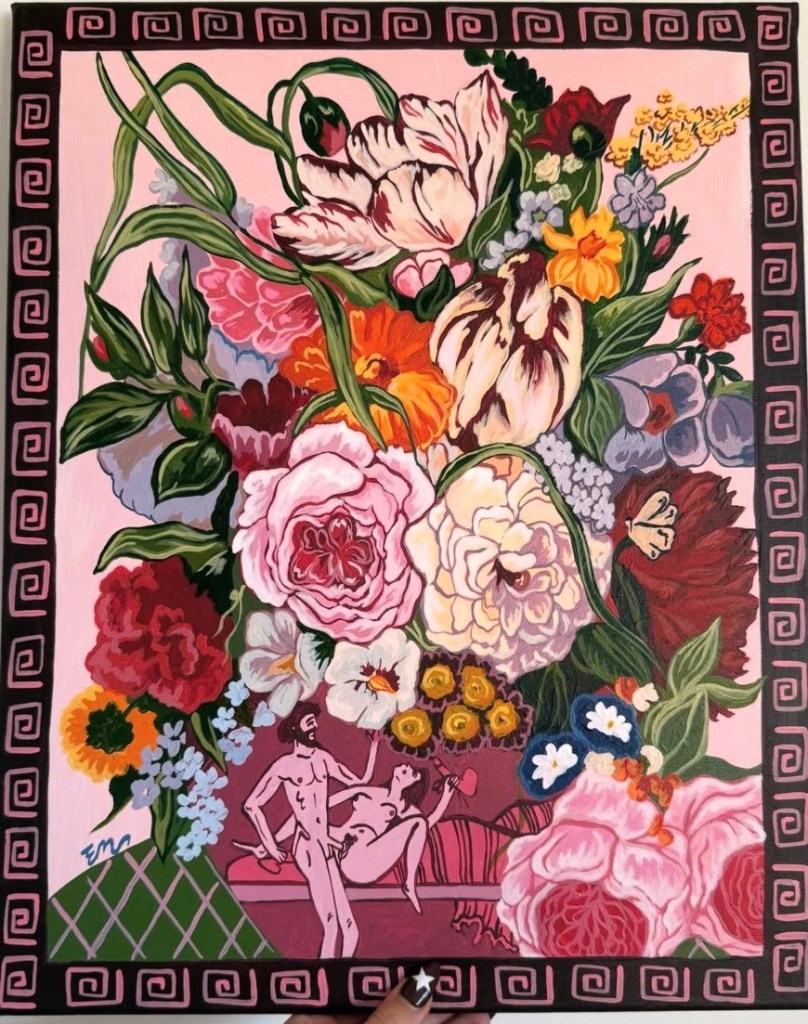
This next artist I actually came across on instagram and am totally obsessed with her work (@malonemily)! She gave me permission to show her work here on the blog! Emily Malone refers to herself as a ‘pop-renaissance’ painter and it is a perfect description. Her popping florals in Greek urns are both eye catching and cheeky to boot! Embracing the sensuality of flora, and the birds-and-the-bees topic matter that the Ancient Greeks were not shy about, come together in a beautifully modern representation of sexual freedom and pleasure. She also has originals and prints for sale on her website!
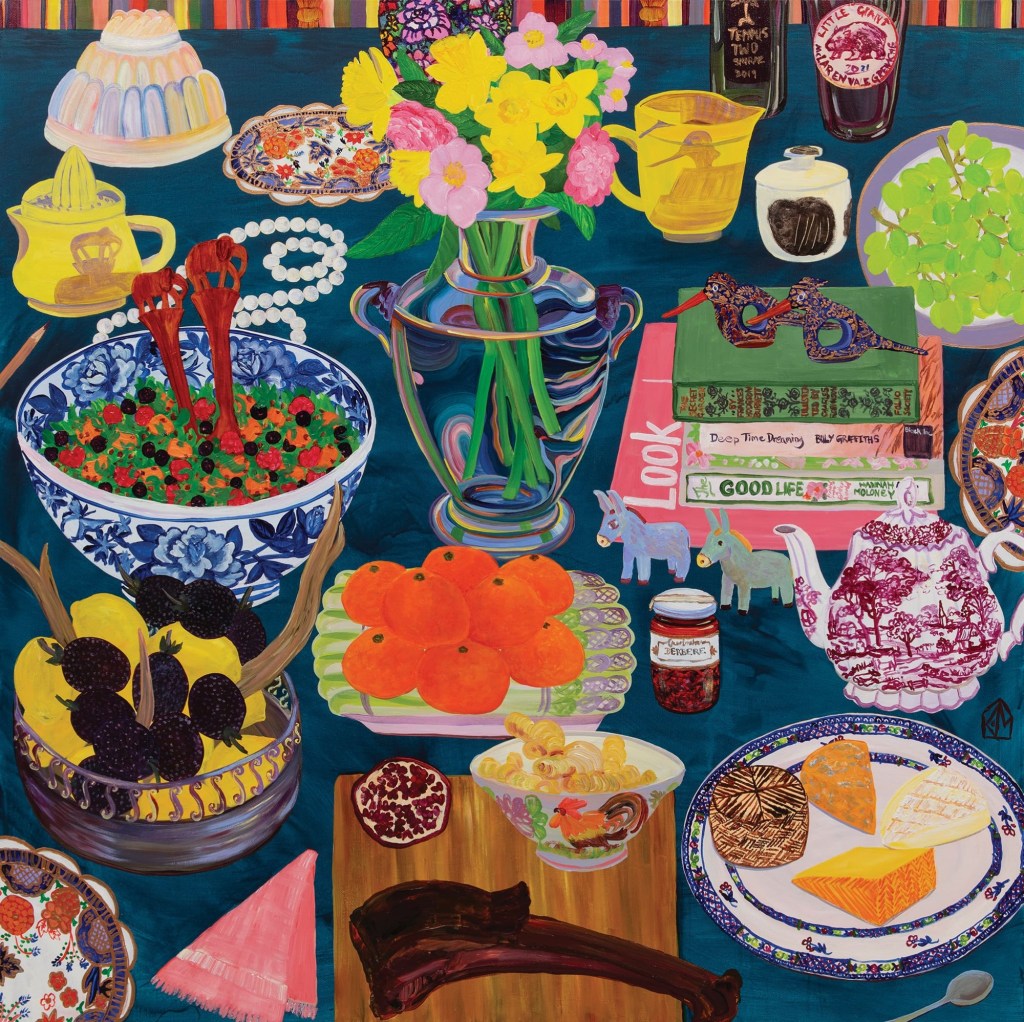
Here we are, our last artist of this post, but certainly not the last still life painter we could discuss: Kiata Mason. Her work, Cooking With Love, is a quirky, 2-dimensional representation of a table right before a dinner party begins. Exactly as I asked you to imagine in the beginning of this post, this table shows all the lovely food and decor on a thoughtfully set table. It’s ready to be enjoyed and this is just a small snapshot that encompasses all the memories about to be made and at the same time as a painting it commemorates those memories after they were created. A time capsule holding both future and past all on one table.
There are so many more female artists who painted still lifes that this post could be a mile long. It wasn’t easy to find them, as it never is with the posts on this blog. Women who painted under appreciated genres of art tend to be swept away from history even more than usual, though. What’s more is that this art genre is actually something we see pretty much all day every day — advertising. Most especially when it comes to products and food! Product marketing and content is really, ultimately, just still life. It’s the particular arrangement of inanimate objects to cause emotion and feeling in the viewer (AKA consumer). The feeling usually being, “buy me”.
More than just an art school exercise, the still life has the ability to transmit secret lives, deep meaning, cultural discourse and the zeitgeist.
I hope you enjoyed the post 🩷. Now go forth and arrange your trinkets, your dishes, some flowers and your dinners. See what lovely snapshots of your life you can capture.
Don’t forget to like, comment, and subscribe to the blog!
Citations
Art Guide Australia https://artguide.com.au/women-in-still-life/
Lucky Strike “Have a Lucky” campaign https://omeka.uottawa.ca/jmccutcheon/exhibits/show/american-women-in-tobacco-adve/weight-and-slimness-advertisem
Deutsche Böre Photography Foundation on Maisie Cousins https://www.deutscheboersephotographyfoundation.org/en/collect/artists/maisie-cousins.phphttps://www.deutscheboersephotographyfoundation.org/en/collect/artists/maisie-cousins.php
Art Institute Chicago on Jan Groover https://www.artic.edu/artworks/212113/untitledhttps://www.artic.edu/artworks/212113/untitled
Museo National Centro De Arte on María Blanchard https://www.museoreinasofia.es/en/collections/artwork/mujer-con-abanico-woman-fan & https://www.museoreinasofia.es/en/collections/artwork/nature-morte-cubiste-cubist-still-life/
Artnet News on María Blanchard https://news.artnet.com/art-world/maria-blanchard-cubist-painter-2488834https://news.artnet.com/art-world/maria-blanchard-cubist-painter-2488834
Art UK organization op-ed on the Life is Still Life show in 2022 https://artuk.org/discover/stories/the-quiet-radicalism-of-still-lifes
Art Institute Chicago’s curator of Lilly Martin Spencer: Hearth, Home, and National Fame on the life of Lilly Martin Spencer https://www.artic.edu/articles/1176/lilly-martin-spencer-hearth-home-and-national-fame
Artsper Magazine’s online post about contemporary still life art https://blog.artsper.com/en/get-inspired/how-contemporary-artists-are-making-still-life-art-cool-again/
The Design Files on Kiata Mason for more about the artists and more works https://thedesignfiles.net/2020/02/art-kiata-mason-the-artists-table-exhibition-sydney
National Museum of Women In The Arts on Gentleman’s Table by Claude Hirst https://nmwa.org/blog/artist-spotlight/artist-spotlight-claude-raguet-hirst-trumping-male-still-life/ & a enhanced digital archived copy by Google https://artsandculture.google.com/asset/a-gentleman%E2%80%99s-table/zgFcXak6LykzVA
Daily Art Magazine on Anne Vallayer-Coster https://www.dailyartmagazine.com/anne-vallayer-coster/
Detailed, and zoomable digital archive of Still Life With Mackerel by Kimbell Art Museum https://kimbellart.org/collection/apg-201901
North American Reciprocal Museum on Vallayer-Coster https://narmassociation.org/anne-vallayer-coster/
Daily Art Magazine on Dutch female still life painters https://www.dailyartmagazine.com/women-of-the-dutch-golden-age/ & https://www.dailyartmagazine.com/vanitas-and-female-artists-a-brief-of-mortality/
Art History Project on Fede Galizia https://www.arthistoryproject.com/artists/fede-galizia/
Hessel, Katy. The Story of Art Without Men. Hutchinson Heinemann, 2022. For info on Rachel Ruysch.


Leave a Reply